In the past few weeks, I've finished
Emma by Jane Austen and
Of Love and Other Demons by Gabriel García Marquez. I've started reading
Cultural Amnesia by Clive James,
Jane Eyre by Charlotte Brontë and
Frankenstein by Mary Shelly. And I greatly enjoy all of these books.
Lately, I have found a propensity for both European and Latin American literature. One reason for this is because I like the images evoked by novels written in certain time periods. I like the sophistication of European culture, the style, and the attitudes. In Latin American literature I like the tropical themes, the magical realism, stories of oppression, and conflict over religion. I feel a connection to European culture because of my ethnic heritage, and a connection to Latin American culture through my friends.


It's strange phenomenon. Though I do not necessarily see physical images of culture in my mind, I sense the presence of the feelings that people had at the time, and how those feelings are similar to our own as human beings. Luke once said, "We poop and pee the same way we did hundreds of years ago." One of the magical things about literature is how each book is evidence that people of the past have suffered with the same difficulties we experience now. I first realized this when I read
Romeo and Juliet in 9th grade. At the time, I was in an angsty mood where I felt like all teenagers were just hormone-ridden fools. When I read the play, it made me feel validated, and I've fallen in love with Shakespeare ever since.
Another reason I've been pulled to literature is because I've felt very inspired by a series of documentaries we've been watching in English class called The Romantics (check it out
here, it even has David Tennant!). Though many people thought the documentaries were dull, I found them quite spectacular. Instead of simply describing the history of romanticism, the documentary worked to recreate the image of Romanticism in a number of ways. One technique they used was imagery. Many clips in the documentary were shadowed depictions of nature, or images of classical buildings. Another technique they used was acting interpretation. They had actors read the lines of Romantic writers and poets in these scenes in the voice of the writers themselves.
The documentaries did a fantastic job of capturing the mood, which I love. I think that one of the best parts of experiencing art is feeling different moods. Art transports you to a plane that once was, but also, never existed. Art encapsulates ideas through feeling, and communicates them through words, sound and images.
In recent times I have moved farther from music and closer to writing. The reason I like writing the most, as of now, is because it is simply the
best communicator of ideas. Music and visual art are very abstract, and while they can have a very profound effect, it is difficult to explain anything concrete. Writing can be both abstract and concrete. In fact, it can be both at the same time.
Writing stems off from another activity I highly enjoy - discussion. I love to talk about complex concepts with people who regard themselves as intellectuals. Unfortunately, I don't have as many of these conversations as I would like. Perhaps this is because I haven't read enough to find issues to discuss, or maybe I haven't found the right people to discuss them with. Oftentimes, when I try to have serious discussions with people, I find that they often put ideology over evidence, and repeat the same things they've heard from their parents and television as if they were their own thoughts. Truth be told, I behave in a similar way, but I am trying my best to become better.

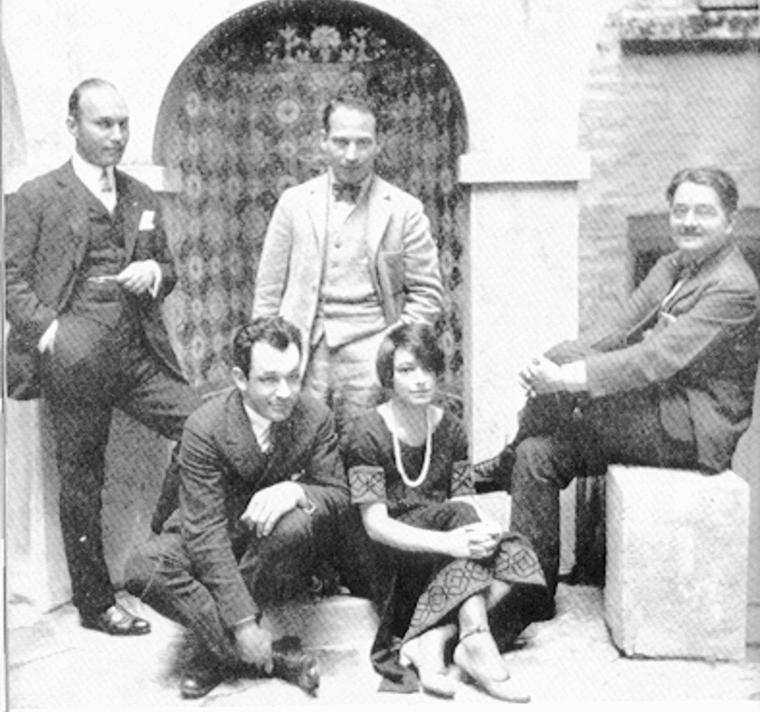
One day, I would live to form a group of intellectuals, like the artists who would meet at Viennese coffee houses, or the Algonquin Round Table. Such a thing may seem outdated in the modern age, but I find that much of my interests are "outdated" in the modern age. I prefer reading over watching TV. I prefer sexual restraint over sexual freedom. I prefer playing cards instead of partying at clubs. It saddens me at times when I see a lack of representation for my kind of person in modern media. Lately I've found that I get along unusually well with Roman Catholics, despite the fact that I am not very religious. I believe in a somewhat more conservative attitude not because I am rigid, but because it makes the most logical sense to me. I don't particularly care what other people do, and quite frankly, I enjoy people who are more liberal and progressive than myself, though I would not want to be them. They seem to deal with more pain and disillusionment than I do.
I've come to accept that I do not like all of the interests of a majority of people, and that the majority of people may never understand the complexities of my mind. This does not bother me, so long as I have people on my plain that I can communicate with so I know that I am not alone.
Hopefully when I am in college, I will be able to find these kinds of people and create my own group. In the modern age, I feel like such a group would be different than in the past. It would have an in person component, but also a technological one. I think that technology is an important tool, but I do not want to take a radically positive or negative point of view upon it.
I want to be like the people Clive James discusses in
Cultural Amnesia. One issue I've had with writing is that I want to write about more complex themes than teenage high school life, but I have very little experience in anything else. I do not have massive amounts of emotional damage, and I do not live in a time of massive political turmoil (perhaps you'll disagree and point to the Republicans, but does that really compare to World War II?). Additionally, I do not like taking radical positions because I do not view any ideology as 100% correct. I could never be an Occupy Wallstreet protestor, because the Occupiers never gave a legitimate solution to the issue of income inequality, and I feel like that would simply foolish. In his book, James says, "It is commonly and truly said that young people who want to set the world to rights learn later to be grateful that the world is not worse than it is; but if they were convinced of that too early, we would lose their critical effect, and the world would be worse still." I may only be seventeen, but I've already gotten to the phase where I realize the world could be so much worse than it actually is. That's not the mindset of a revolutionary, which I know from reading
The True Believer by Eric Hoffer.
So what's left for me? I don't know to be honest. The only point that I can argue is that all points are inherently invalid. That's what pulls me to satire, especially in the Enlightenment style like
Candide. In a way, satire is the anti-art. It exists as a subversion to the ideology and emotionality that art stands for.
Sometimes, I feel at odds between logic and emotion. While I think that many of the ideas of Romanticism are silly and maybe even pretentious, I cannot help but feel a yearning for the romantic lifestyle of experiencing nature and searching for the purest feeling that will never truly exist on this plane.
I am torn between the mentality of the Enlightenment and Romanticism, and this has started to reflect itself in my writing. My pieces were originally humorous, but they have started to reflect some more serious undertones as I keep writing them. I fear the element of emotion in art, because I feel like oftentimes it is shallow, forced, and immature. If I am including it naturally though, it will likely not appear this way.
I feel like the mood of our time period is fairly satirical, Enlightenment-like. Our most important figures are comedians like Jon Stewart and Steven Colbert. People enjoy media out of irony instead of actual quality. Our current youth movement, hipsters, live in constant denial of their own existence. It's bizarre if you really think about it.
While I love the satirists and comedians, I feel like we could use some more serious, and more magical, Romanticism art. Because we have access to so much information, it is easy to prove people's fantasies wrong, which is why there is so much satire. Blind devotion is less common, which is mostly good, but occasionally bad. For example, most American citizens have been disillusioned with presidents since Nixon for legitimate reasons. On the other hand, this means that we no longer have leaders that people truly idolize, and thus less inspiration. This is why movies like Frozen appeal so much to people. Fantasy stories bring back some of the magic that we have lost by being realistic.
I suppose that makes me a political realist and an emotional idealist. An interesting combination, but not necessarily a mutually exclusive one. I believe in a flexible but stable political system that allows people to live out their fantasies to the best of their abilities. Even in the failure to achieve these ideals, there is beauty in the interesting plot lines that life develops that cannot even be preconceived beforehand.
In the coming weeks, I hope to read some more of this literature. Perhaps I will also watch more films and television shows. I am voracious for media, especially media with cultural significance, because it makes me feel as if I am part of the collective whole of humanity.
In terms of personal projects, I plan on simply writing whatever I please. I've started to realize that so much of my time is wasted away by mindless texting because I get too distracted to pick out a legitimate activity. Pomodoro has helped me so much with this. When I do a Pomodoro, I spend 25 minutes working, and then 5 minutes mindlessly texting. I don't have to pick anymore. I can do both! It makes me feel productive but not isolated. I plan on doing much more Pomodoro in the future.
At this point, with college so close in view, I no longer feel the pressure to find a specific activity that I must do in order to discover my life passion. I trust that I will figure out my future career path in college. For now, I am simply doing what I want, as long as it's productive. And who knows, maybe all the reading and writing I am doing is secretly training me for what I will be doing in college and beyond.


.jpg)


