This is the End
Being that this blog has mostly been my artistic conversation with Luke, and being that I am now graduating STAC and moving onto the next phase of my life, I believe that it is time for me to bring this artistic journal, and phase of my life, to a close.
I have had some incredible times on this blog. It first began with my introspection into a world beyond reality; into a world of confusion and emotional turmoil. It moved into a blog documenting the process of my projects. Then it became my way of analyzing art and developing my library. Finally, it concluded as a combination of all three.
As I've said many times before, writing is how I make sense of the crazy and erratic thoughts in my mind. When this blog is gone, I will trust on my own that I am on the right track. I won't have Luke or anyone else to check on me. I'm taking off the training wheels and riding the bike. Not that Luke checked up on me too much anyhow, trusting that I basically knew what I was doing. Still, it is different now, without that pyschological cushion.
Right Now
Where do I stand? Well, this summer I am working for my father, taking Spanish tutoring, and travelling back to Romania. I can tell you that after all the stress of high school, I am delighted to have a bland office job. Half the time, I'm just reading the news or reading books while waiting for things to do. It's a simple, consistent life, and I like it quite a lot. It feels rewarding to work for money. At work, you get paid for your toils. At school, they give you a stupid amount of work and tell you "This is your own reward, so shut up."
I don't know if I would want to work an office job like that for the rest of my life, but if I were working for a corporation I truly believed in, I think I would be very happy. I could see myself as a higher executive of some sort. But I also feel I would want a job that involves interacting with people more, such as being a teacher. There are many possibilities. The future is bright.
I still have a desire to write and make art. However, I've been so happy to have free time, I've spent much of it lounging around. I started reading Diaries from a Young Poet by Rainer Maria Rilke, which I don't think is one of his more famous works, but I find it gratifying nonetheless. In a way, this blog has been my diary as a young artist. Many of my thoughts were concurrent with his. If I binded it in a book, could I market it? Probably not, but it's a nice thought.
I don't know if I want to become a full time artist, even if I had the choice. They say "if you do what you love, you'll never work a day in your life." Bullshit. Everything is work. When I was pulling together my book, was it all fun? No way! Sometimes it really sucked! I was not doing what I loved. I was doing something I needed to do that I mildly enjoyed but also drove me insane. So really, it doesn't matter if I'm working in art or anything else, because I'm going to be working no matter what. What matters is if, in the long run, you're happy with what you've accomplished and how you've contributed to improving society. That's what makes the work worth it, no matter what field you work in.
The Plan
STAC Blog
I am going to save a backup of this in a few safe places. Then this will be removed from the internet. Goodbye everyone.
EllenRoseWrites
I will backup and clear this out as well. My best posts are in my book, so there's no need to put them online. And everything else is just junk. Once I clear it out, I will decide what to do based on what I feel like writing and what I feel like posting.
My Personal Development
In lieu of my blog, I will start to journal more about my artistic issues as well as my thoughts for the future in general. This will help me maintain direction. Often, you know what you want to do deep down. It's simply a matter of listening.
Showing posts with label Journey. Show all posts
Showing posts with label Journey. Show all posts
Thursday, June 19, 2014

Friday, June 6, 2014
Foucault's Pendulum
I once read a New York Times article that said there is no shame in taking a break from or abandoning books. We are not obligated to books.
I must admit, I am extremely confused about what is happening in Foucault's Pendulum. I breezed through much of the middle on a car ride to Rochester, and I don't think I was paying enough attention, because I feel like I've basically opened to a random page. I am having a lot of difficulty following all of the medieval stories, and I think there are fundamental historical facts that I still don't know. For example, I still don't know what the Rosicrucians are, even though the book probably explained it and they are mentioned nearly every five pages.
One thing that I could do is start the book over from the beginning and try to catch up on what I missed. This, however, seems like a LOT of time that I do not feel like investing.
So I don't think I shall be joining Foucault's Pendulum Club. I am somewhat disappointed, but there are also many other books that I want to read, and I'm ready to move on to them, at least for now.
If someone can explain to me what's happening enough so I can figure out what I missed, I'll continue, but otherwise I'm throwing in the towel.
I must admit, I am extremely confused about what is happening in Foucault's Pendulum. I breezed through much of the middle on a car ride to Rochester, and I don't think I was paying enough attention, because I feel like I've basically opened to a random page. I am having a lot of difficulty following all of the medieval stories, and I think there are fundamental historical facts that I still don't know. For example, I still don't know what the Rosicrucians are, even though the book probably explained it and they are mentioned nearly every five pages.
One thing that I could do is start the book over from the beginning and try to catch up on what I missed. This, however, seems like a LOT of time that I do not feel like investing.
So I don't think I shall be joining Foucault's Pendulum Club. I am somewhat disappointed, but there are also many other books that I want to read, and I'm ready to move on to them, at least for now.
If someone can explain to me what's happening enough so I can figure out what I missed, I'll continue, but otherwise I'm throwing in the towel.
Thursday, June 5, 2014
I Finished
I finished and I am in shock.
I did it again. I did an entire crazy self-produced project again.
And now that I did it again, I completely understand why I was so traumatized the first time, and why I abandoned music completely.
Making art product isn't just difficult. It's extremely difficult.
When I made the transition between creating for my blog and creating for my book, I did not realize how drastic it would be. Creating for my blog was a lot of fun for me. Even when I wrote something bad one day, I would have fun writing something else the next day. I kept it up for 100 days. That's a significant achievement. People enjoyed reading my blog. I even had someone find me during school to tell me how much she liked it.
Writing was my way of making sense of the world. It helped me contextualize my thoughts, and it also gave unpresidented solutions to my current conundrums. Writing was a way of mentally filing my thoughts about the things I could not discuss.
When I started the book, I stopped my daily creative writing because I simply lacked the time and energy. And I do miss it.
In the beginning of the project, I started seeing the same problems I encountered two years ago that I completely forgot about. Stress. Burnout. Time constraints. Perfectionism. Criticism.
It felt like Deja Vu, and in more ways than one. I realized that my last two years of high school were quite similar to my first two years of high school. They both began with an emotional crisis, and ended in a massive final project. Even many of the events in between are similar, but I don't want to get into details.
I was afraid that I would run into the same issues again. However, as I reflected further, I saw that I had fixed many of the mistakes I made in my first two years of high school. Instead of being depressed, I was happy. Instead of passing off school work, I was achieving the highest grades I'd ever received in my life. Instead of destroying my social relationships, I was healing them.
And now, I was going to do this project the right way.
My primary goal became to avoid burnout while still making a worthwhile project. In many respects, I succeeded. In other respects, I failed miserably. There were nights where I only got four hours of sleep because I couldn't get the project out of my mind. There were times where I ranted about all the work I had to do, probably for longer than I should've. However, I never yelled, I still did all my homework for my classes, plus my other STAC projects, and I even managed a social life in between.
Today was a rough day, and I must admit I didn't maintain my composure the whole time. In addition to feeling the final day pressure of the project, I was also attempting to sign up for my college classes for the first time (of course all the classes I wanted to take were full, and I somehow managed to place into Intermediate Spanish even though I've never taken a Spanish course in my life), I screwed up my homework for my behavior economics seminar, and my brother got me an oreo smoothie even though I don't like chocolate. Small things, but when the pressure is already built up, it's very easy to explode. I took a nap while listening to obscenely happy music, and thankfully that calmed me down before I started becoming really emotional.
That's the thing about emotions. Sometimes your mind has to say "Look, I know you feel upset right now, but you really have to calm down or else you may do something you'll regret later. The feelings will pass. You do not need to act upon them." Then you go and do a mindless activity you enjoy, like sleeping, or browsing Pinterest, or reading a book, and it's all okay in the end.
So I did a better job taking care of myself emotionally, and that's great. However, that's not the most important thing I learned during this project.
No. The most important thing I learned was having my own opinions.
I made the cover for my book, and I showed it to a bunch of people because I thought it looked quite nice. Most people agreed. However, I had a friend who told me he didn't like the green boxes because they looked "old fashioned, too much like 2006 graphic design." I was also told that my cover was not very relevant to my book, and the bland alternative cover I created was a better choice because it was more relevant.
I did it again. I did an entire crazy self-produced project again.
And now that I did it again, I completely understand why I was so traumatized the first time, and why I abandoned music completely.
Making art product isn't just difficult. It's extremely difficult.
When I made the transition between creating for my blog and creating for my book, I did not realize how drastic it would be. Creating for my blog was a lot of fun for me. Even when I wrote something bad one day, I would have fun writing something else the next day. I kept it up for 100 days. That's a significant achievement. People enjoyed reading my blog. I even had someone find me during school to tell me how much she liked it.
Writing was my way of making sense of the world. It helped me contextualize my thoughts, and it also gave unpresidented solutions to my current conundrums. Writing was a way of mentally filing my thoughts about the things I could not discuss.
When I started the book, I stopped my daily creative writing because I simply lacked the time and energy. And I do miss it.
In the beginning of the project, I started seeing the same problems I encountered two years ago that I completely forgot about. Stress. Burnout. Time constraints. Perfectionism. Criticism.
It felt like Deja Vu, and in more ways than one. I realized that my last two years of high school were quite similar to my first two years of high school. They both began with an emotional crisis, and ended in a massive final project. Even many of the events in between are similar, but I don't want to get into details.
I was afraid that I would run into the same issues again. However, as I reflected further, I saw that I had fixed many of the mistakes I made in my first two years of high school. Instead of being depressed, I was happy. Instead of passing off school work, I was achieving the highest grades I'd ever received in my life. Instead of destroying my social relationships, I was healing them.
And now, I was going to do this project the right way.
My primary goal became to avoid burnout while still making a worthwhile project. In many respects, I succeeded. In other respects, I failed miserably. There were nights where I only got four hours of sleep because I couldn't get the project out of my mind. There were times where I ranted about all the work I had to do, probably for longer than I should've. However, I never yelled, I still did all my homework for my classes, plus my other STAC projects, and I even managed a social life in between.
Today was a rough day, and I must admit I didn't maintain my composure the whole time. In addition to feeling the final day pressure of the project, I was also attempting to sign up for my college classes for the first time (of course all the classes I wanted to take were full, and I somehow managed to place into Intermediate Spanish even though I've never taken a Spanish course in my life), I screwed up my homework for my behavior economics seminar, and my brother got me an oreo smoothie even though I don't like chocolate. Small things, but when the pressure is already built up, it's very easy to explode. I took a nap while listening to obscenely happy music, and thankfully that calmed me down before I started becoming really emotional.
That's the thing about emotions. Sometimes your mind has to say "Look, I know you feel upset right now, but you really have to calm down or else you may do something you'll regret later. The feelings will pass. You do not need to act upon them." Then you go and do a mindless activity you enjoy, like sleeping, or browsing Pinterest, or reading a book, and it's all okay in the end.
So I did a better job taking care of myself emotionally, and that's great. However, that's not the most important thing I learned during this project.
No. The most important thing I learned was having my own opinions.
I made the cover for my book, and I showed it to a bunch of people because I thought it looked quite nice. Most people agreed. However, I had a friend who told me he didn't like the green boxes because they looked "old fashioned, too much like 2006 graphic design." I was also told that my cover was not very relevant to my book, and the bland alternative cover I created was a better choice because it was more relevant.
 |
| Bland Alternative Cover |
I told Luke these concerns, and his response was something along the lines of "2006? What the heck was graphic design like in 2006? Does this kid even know what he's talking about? I don't think these opinions are helping you. You don't need these opinions. You shouldn't even ask for these opinions. You can decide things for yourself."
Most people hearing that would probably agree and move on. But me? I nearly started crying, precisely because this is an issue I've been having a lot of difficulty with, not only as an artist but as a human being.
I realized that I seek confirmation in nearly everything that I do. And I mean everything. Art opinions, political opinions, opinions about school, opinions about what I should be doing in college, opinions about other people, even opinions about how hungry I feel in my own stomach.
As I went home that day, I thought about how I feel pressured by the people around me who tell me what I should do and think. I also thought about how I often attach myself to these kinds of people intentionally. If I don't like the pressure, why do I keep inviting people to come in and push me around?
I think that deep down, my fear was that I wasn't a good person. Left to my own devices, I feared that I would make the mistakes I always make that cause pain to myself and others.
However, after meditating to myself, I saw that deep down, I am not a bad person. My animal instincts are not nihilistic. I make mistakes as much as anybody else does.
Perhaps I felt that if other people decided things for me, I could blame my mistakes on them, and therefore not feel as bad about myself.
I thought about the times that people asked for my opinion, and I said things that were outright junk just to prove that I had something valid to say. If that was what I did for other people, isn't that exactly what people were doing to me? Most of the opinions people were giving me were probably half-assed, just a statement to prove they had something to say. Why do I need other people's half-assed opinions when I have my own? In fact, my own opinions are probably better for me, because I know myself better than others know me, and therefore I have an ability to make better choices for myself.
I'm starting to internalize a lot of things. Many say internalization is bad, and I would agree with that in most cases. For me however, I think internalization is empowerment. It's basically me saying, "I have these thoughts and opinions, and I'm not even going to say them because I don't care what you think."
Sharing invites opinion. Always. There will always be people who need to give some kind of response, even when it's not welcome. That's why it is good to be careful with your words.
I must admit, when I began this post, I planned to talk about how completing a massive project puts you into a state of shock that borders on existential crisis. But now, I'm feeling more optimistic.
Does this book have mistakes? Probably. Are there things I could have done better? Oh yeah.
But the most important thing is that I have matured a lot, and the lessons I learned during the process of completing this project will make me a better person for the rest of my life.
As I went home that day, I thought about how I feel pressured by the people around me who tell me what I should do and think. I also thought about how I often attach myself to these kinds of people intentionally. If I don't like the pressure, why do I keep inviting people to come in and push me around?
I think that deep down, my fear was that I wasn't a good person. Left to my own devices, I feared that I would make the mistakes I always make that cause pain to myself and others.
However, after meditating to myself, I saw that deep down, I am not a bad person. My animal instincts are not nihilistic. I make mistakes as much as anybody else does.
Perhaps I felt that if other people decided things for me, I could blame my mistakes on them, and therefore not feel as bad about myself.
I thought about the times that people asked for my opinion, and I said things that were outright junk just to prove that I had something valid to say. If that was what I did for other people, isn't that exactly what people were doing to me? Most of the opinions people were giving me were probably half-assed, just a statement to prove they had something to say. Why do I need other people's half-assed opinions when I have my own? In fact, my own opinions are probably better for me, because I know myself better than others know me, and therefore I have an ability to make better choices for myself.
I'm starting to internalize a lot of things. Many say internalization is bad, and I would agree with that in most cases. For me however, I think internalization is empowerment. It's basically me saying, "I have these thoughts and opinions, and I'm not even going to say them because I don't care what you think."
Sharing invites opinion. Always. There will always be people who need to give some kind of response, even when it's not welcome. That's why it is good to be careful with your words.
I must admit, when I began this post, I planned to talk about how completing a massive project puts you into a state of shock that borders on existential crisis. But now, I'm feeling more optimistic.
Does this book have mistakes? Probably. Are there things I could have done better? Oh yeah.
But the most important thing is that I have matured a lot, and the lessons I learned during the process of completing this project will make me a better person for the rest of my life.
Monday, May 26, 2014
Design and Branding
In the beginning of April, I developed a spontaneous interest in graphic design. I particularly liked Swiss graphic design because of its simplicity and purity.
These are basically the standards for Swiss international style


For my book, I thought it would be a good idea to implement this style. It's easy to do, it looks goods, and I like it.
Covers
These are my drafts for the front and back cover so far. I haven't decided as a title yet, so I simply put "Malarkey." The back will likely be filled with false praises.


One solution is to center the text.


These are basically the standards for Swiss international style
- Sans-serif font in focus (specifically fonts like Helvetica)
- Angles
- Geometric shapes
- Monochromatic images
For my book, I thought it would be a good idea to implement this style. It's easy to do, it looks goods, and I like it.
Covers
These are my drafts for the front and back cover so far. I haven't decided as a title yet, so I simply put "Malarkey." The back will likely be filled with false praises.
I put a rose on the front cover because my name middle name is Rose and my blog was Ellen Rose Writes so it seemed appropriate. On the back I wanted the image of a garden, so I put a field of tulips. The green boxes are there for flavor. I think they add a nice touch.
The front cover has its text and images at an angle, while the back cover is parallel. I'm not sure if this inconsistency is an issue.
I am very pleased with this design, although I do not know how relevant it is to my book or its content. That is a bit concerning, but I could probably make something work.
Interior Layout
Translating Swiss design to the interior is not an easy task, considering that the design was mostly utilized on covers, which are more imagistic and less paragraph-based.
Fonts
To keep up the consistency of the cover title font, I made the headings in Helvetica (particularly Helvetica Neue but the two are quite similar). The text I put in Garamond because a number of websites recommended the two as a good match, and one website said that sans-serif fonts in large paragraphs are difficult to read, which I agree with.
Images
I've been debating how to include images into my work. Pieces that have long sentences and paragraphs do well with an accompanying top image.
However, poetry or lists do not fair well with this layout.
 |
| Text, where you go? |
Another solution is to put the image on the previous page.
Geometric shapes work well for my soap suds piece, because I can make the circles represent soap suds. However, some other pieces don't lend as well to pure geometric shapes.
To maintain the style, I made some images monochromatic.
 |
Concerns
I have two primary concerns
1. Is Swiss style too edgy/robotic?
Yes, the covers look great, and its nice to have a clean aesthetic. However, is there TOO much Helvetica? Does the edgyness of the design detract from the material?
In addition, am I losing out by not utilizing my drawing skills that I've been recently developing? Though I am not utilizing these skills, I do save time by creating everything digitally, and I do think it is a valid design choice.
2. How will I get all of the images I need?
I want to avoid copyright as much as possible. This involves making my own images. The first image of the soap suds was made by me. The second picture was a photograph taken by me. Simple enough.
What about another piece that is dedicated to Tommy Wiseau? How am I supposed to get an image of him without copyright issues? I don't even know how I would create one of my own.
Other pieces like Io the Disney Princess may require me to take my own photographs. This is possible, but it is also time consuming.
I basically have nine days from this point, and I still haven't revised all of my pieces.
Does every piece even need an image? I suppose that's something else to ask.
Summary
I do think I can pull this off if I cut corners. I've already started and I have many images done.
I would like to know if I'm going in the right direction with my bold design choices, or if my book is starting to look too mechanical.
Sunday, May 18, 2014
Too Personal
I am coming into contact with an issue that many artists likely face once they start to make enough work, but I shall discuss it anyhow.
Art is autobiographical. But when does art get too autobiographical?
As I talked about in my previous post, I'm generally averted to serious art because it seems too linked to me emotionally. This causes some issues.
Art is autobiographical. But when does art get too autobiographical?
As I talked about in my previous post, I'm generally averted to serious art because it seems too linked to me emotionally. This causes some issues.
- People may not care about my emotions very much, and thus it might be more of a self-satisfying rant than anything else
- People might start questioning my personal motivations for each piece, thus trying to examine and analyze my psychological issues more than I am comfortable with
- It's hard to emotionally detach from the work, making it more difficult to digest criticism
- Most of the time, I am not a very serious person, and writing serious pieces can put me in a mood that I don't like, or that I do not see as a predominant mood
Let me address each of these one by one
Who Cares?
There are two answers for this.
(1) I care about my work, even if no one else does. I can write work without the intention of sharing it with anyone, and that's okay.
(2) If other people care about my work, that gives it public value. What determines if they care? I don't know, but if they care, then it's important. Nirvana was the music of one incredibly angsty man, but a lot of people care to hear it. Allie Brosh only writes stories about herself, and people care about that.
Close friends and family generally care about my work, mostly because they are obligated to. How can I tell if other people care? I suppose I simply need to put myself out there more. If I don't get positive responses, clearly I will have to change something.
Psychoanalysis
I don't want my art to turn into Read It and Weep. For those who don't know, it's a Disney channel film about a girl whose diary becomes a best seller, and all the people in her life realize the characters are based on them, which causes them all to hate her. That's scary! I don't want to do that. I love my friends. Though I get upset with them sometimes (as everyone does with their own friends), overall they are incredibly wonderful people.
Of course, it's usually negative emotions that drive you to make art. You don't make a story about "the day that was wonderful where nothing went wrong." So if art tends to be autobiographical, and art is also inspired by negative experiences, that could make a dangerous combination if one is not careful.
Still, you have people like Taylor Swift who write about all of their ex-boyfriends, and people eat up that crap like desert.
I think the best way to deal with this is to listen to my gut. If I think, "This could cause problems," then there's a really good chance I'm right. If you've seen some of the stuff I've written on this blog, or the crap that's come out of my mouth, you can see that I am a person with few boundaries. So if my gut is trying to tell me something, I'm probably doing something very risky, and I should re-evaluate.
Emotional Detachment
I think the simple solution to this issue is time. Right when I write something I care about it. Next week I care a little less. A month later and it's sitting at the bottom of my dusty mental shelf, beneath the new load of things I have written to supplant it.
Mood
I think the way to deal with mood is to simply make a choice on the mood that you want. Of course, you don't want to make a choice that suppresses your creativity. On the other hand, you need to be careful of engaging too heavily in certain moods, or else you will go insane.
For example, I realized listening to Nirvana would worsen my already negative mood and lead me to make poor decisions. It would perpetuate bad feelings and bad habits. So, I forbade myself from listening to Nirvana nearly two years ago. That's also about the same time my enduring depression ended. There is probably more of a correlation between the two than I would like to admit.
Nirvana is an excellent band, no doubt. But I can't make art like Nirvana because Nirvana has caused harm to my life, and I would never want to do that to other people. Yes, it was also good for me to listen to Nirvana when I was depressed because I felt like Kurt Cobain sympathized with me, but the relationship between me and the ghost of Cobain was horribly toxic.
Some artists thrive in negativity. Negativity is addictive, both to the artist themselves and the consumer of art. Must we sacrifice sympathy for emotional stability?
Let me give you a notorious example. In Goethe's book The Sorrows of Young Werther, the protagonists commits suicide in a glorified manner. This resulted in a phenomenon called copycat suicide, where men were inspired by Young Werther to take their own lives.
Should Goethe be at least partially responsible for these deaths?
Of course that's pretty extreme, but I think it gets my point across.
I think the decision of mood has been at least partially made for me. I do not want to make art that drives people to be depressive or suicidal. At the same time, I do not want to be a comedic fluff, or else I wouldn't be having this conflict in the first place.
Where is the balance? Perhaps I will not understand my general mood (and general style) until I make more work. I will have to swing between two sides of the pendulum before I fall into balance.
Although after bringing up this idea, I'm actually very interested in discussing the question of art and mood, and art's obligation to society as a mood setter.
Although after bringing up this idea, I'm actually very interested in discussing the question of art and mood, and art's obligation to society as a mood setter.
Friday, May 16, 2014
Serious Art and Victory Lap (by George Saunders)
Serious Art
Most of this week, I haven't been doing my usual silly daily posts. I haven't wanted to write lists. I've wanted to write stories. Somewhat humorous stories, but mainly serious. I don't know why exactly. Perhaps the stress of APs put me in a more somber mood. Or maybe I'm starting to mature...Maybe not that.
I've always had more ambivalent feelings about serious art. I think this is because I set up a construct for myself where I can only tell a tragic experience if I've had a decent amount of personal experience dealing with it. Otherwise, I wouldn't know what it's like, and the story would simply come out shallow. On the other hand, I do not think my life is very tragic, so my material is limited. In addition, I think that simply writing about myself over and over again is sophomoric. Of course every piece of art is autobiographical, but when it becomes more explicit, where is the line between art and whining?
This is why I feel much more comfortable in humor. Humor isn't feeling emotion. It's mocking emotion. It's so much easier to mock emotion than to feel it, because feeling emotion is uncomfortable and unpleasant. Not to mention, it is easier to handle criticism for a humorous piece than for a serious one, because a criticism for a serious piece feels more personal. Also, I think I'm better quality-wise at humor.
In my ideal world, I would be able to combine both seamlessly and create a story that contained emotional depth without overdoing it. Something that says "This is how people feel, and it's kind of silly, but it's worth acknowledging nonetheless because it's tough to deal with."
I think this has something to do with my attitude about emotions in general. I believe that emotions should not be ignored, but at the same time, I think giving them too much value causes people to be controlled by their emotions, which leads them to making poor decisions. There is a line between underacknowledgment and overacknowledgment, but it is blurry.
Regardless of my apprehensions, I've decided to try and write serious stories anyway. I actually enjoy them quite a bit, because I find them a useful way to work through my own thoughts and issues. My art has given me insights on my own life. I'll give myself better advice in my art than I do in my head. Isn't that funny?
If my work seems mediocre and juvenile, I don't think that's much of a surprise considering that I'm only seventeen. Also, I only started creative writing on a regular basis a few months ago. At this point, I think I'm still allowed to suck.
Victory Lap
Now this is only the first George Saunders piece I have read, so I do not I have seen enough to make judgments about him as a whole. But I definitely had some strong opinions about the piece that I did read.
Saunder's style was completely unexpected to me when I first read it. Nearly every sentence was a fragment, proper grammatical rules for dialogue were completely abandoned, and he used {} symbols, which I can't even name. I don't think I actually understood what was happening until I was halfway through the story. The more I read, the more I enjoyed Saunder's style. It's an adapted taste, like Tom Waits.
When I reached the end, I had very mixed feelings about the story as a whole. My problem with it is that it did not seem realistic. I'm not saying that all stories need to be realistic. Science fiction is great. However, I felt like it was passing itself off as something legitimately realistic, even though the situation did not seem very plausible. This made the piece seem a bit contrived to me. I know that pedophiles and crazy people exist, but the whole scenario of a man going to a girl's house and having the girl be rescued by a teenager beating the man in the head with a geode, I don't know. Maybe the flaw is with the genre more than the writer. Maybe it's just not my type of art.
After reading Victory Lap and having these complaints, I decided to try to write my own piece in his style that seemed more realistic. They say "make the art that you want to see." That's what I did.
But being of serious nature, I don't particularly feel like sharing it.
Most of this week, I haven't been doing my usual silly daily posts. I haven't wanted to write lists. I've wanted to write stories. Somewhat humorous stories, but mainly serious. I don't know why exactly. Perhaps the stress of APs put me in a more somber mood. Or maybe I'm starting to mature...Maybe not that.
I've always had more ambivalent feelings about serious art. I think this is because I set up a construct for myself where I can only tell a tragic experience if I've had a decent amount of personal experience dealing with it. Otherwise, I wouldn't know what it's like, and the story would simply come out shallow. On the other hand, I do not think my life is very tragic, so my material is limited. In addition, I think that simply writing about myself over and over again is sophomoric. Of course every piece of art is autobiographical, but when it becomes more explicit, where is the line between art and whining?
This is why I feel much more comfortable in humor. Humor isn't feeling emotion. It's mocking emotion. It's so much easier to mock emotion than to feel it, because feeling emotion is uncomfortable and unpleasant. Not to mention, it is easier to handle criticism for a humorous piece than for a serious one, because a criticism for a serious piece feels more personal. Also, I think I'm better quality-wise at humor.
In my ideal world, I would be able to combine both seamlessly and create a story that contained emotional depth without overdoing it. Something that says "This is how people feel, and it's kind of silly, but it's worth acknowledging nonetheless because it's tough to deal with."
I think this has something to do with my attitude about emotions in general. I believe that emotions should not be ignored, but at the same time, I think giving them too much value causes people to be controlled by their emotions, which leads them to making poor decisions. There is a line between underacknowledgment and overacknowledgment, but it is blurry.
Regardless of my apprehensions, I've decided to try and write serious stories anyway. I actually enjoy them quite a bit, because I find them a useful way to work through my own thoughts and issues. My art has given me insights on my own life. I'll give myself better advice in my art than I do in my head. Isn't that funny?
If my work seems mediocre and juvenile, I don't think that's much of a surprise considering that I'm only seventeen. Also, I only started creative writing on a regular basis a few months ago. At this point, I think I'm still allowed to suck.
Victory Lap
Now this is only the first George Saunders piece I have read, so I do not I have seen enough to make judgments about him as a whole. But I definitely had some strong opinions about the piece that I did read.
Saunder's style was completely unexpected to me when I first read it. Nearly every sentence was a fragment, proper grammatical rules for dialogue were completely abandoned, and he used {} symbols, which I can't even name. I don't think I actually understood what was happening until I was halfway through the story. The more I read, the more I enjoyed Saunder's style. It's an adapted taste, like Tom Waits.
When I reached the end, I had very mixed feelings about the story as a whole. My problem with it is that it did not seem realistic. I'm not saying that all stories need to be realistic. Science fiction is great. However, I felt like it was passing itself off as something legitimately realistic, even though the situation did not seem very plausible. This made the piece seem a bit contrived to me. I know that pedophiles and crazy people exist, but the whole scenario of a man going to a girl's house and having the girl be rescued by a teenager beating the man in the head with a geode, I don't know. Maybe the flaw is with the genre more than the writer. Maybe it's just not my type of art.
After reading Victory Lap and having these complaints, I decided to try to write my own piece in his style that seemed more realistic. They say "make the art that you want to see." That's what I did.
But being of serious nature, I don't particularly feel like sharing it.
My Future Art
The works that I've been gathering for my book have been the best humorous pieces. However, if some of my more serious pieces are legitimately good, I may want to include them too and give the book a theme of duality.
Before I decide that though, I need someone to tell me if my serious work is junk or not, because it's difficult for me to tell.
Saturday, May 10, 2014
Personal Style
The post that I am about to embark on is going to be strange and abstract, but it is absolutely related to my artistic process and development.
The more I make art, the more I am coming to understand that art is a metaphor for the self. One comes to understand themselves through art, and art improves through understanding of oneself. It also comes through artistic technique, speaking of which, I just used chiasmus in that previous sentence.
Technical understanding of the craft is absolutely important, and I don't mean to diminish its value. That is why I feel conflicted over the issue of art and the self.
When I say art and the self, I am basically talking about autobiographical art.
Of course all art is autobiographical. However, there is a difference between art that is explicitly autobiographical and art that attempts to be universal.
I feel conflicted over the concept of autobiographical art. Part of me wonders why I should care so much about another person's generally average life. In comparison to the livid world of fiction, personal stories are definitely less adventurous and more monotonous. On the other hand, I've read autobiographical art that I've greatly enjoyed, partially because of its relatable banality.
As I mentioned in a previous post, I read Hyperbole and a Half by Allie Brosh. The book is composed of written stories and accompanying cartoons about Brosh's life. Though Brosh's life is remarkably average, she shared her stories in a humorous and touching way, which made them worth reading.
After reading her book, I decided to spoof her technique in a blogpost called My Depression, named after a story in her book with the very same title.
Some say art is therapy, and that post was most certainly therapeutic. After I completed it, not only did I I have a better comprehension of my own depression, but also I had a closer understanding of myself.
This week I did two other posts that were directly related to myself. One was a time capsule letter and the other was a series of diagrams depicting my physical characteristics at different points in my life.
I think it was especially helpful for me to make these autobiographical pieces, because of the nature of my personality. I feel as if I have many personalities living within me at once, and this causes internal conflict. Sometimes I'm caring, other times I'm cynical. Sometimes I'm assertive, other times I'm shamefully passive. Sometimes I'm mature, other times I'm childish. What is Ellen? What is Ellen-esque art?
And that is how this relates back to my process. I believe that a better knowledge of the self leads to a more coherent style of art. Pushing off from that, I think a coherent style makes it easier to formulate more pieces in the future. If you already have a sense of what you want to create, all you have to do is physically get it done.
I've been creating art for years now, and I still can't put a finger down on what my style is, just like I can't dedicate myself to a single personality. I think there is a disparity between who I want to be and who I actually am. I want to be tough enough to assert my opinions with snarky wit, but gentle enough to avoid stubborness and show genuine care for others. That might not even be possible to have in one human being, but that's what I want.
The reality is, I'm a pretty sensitive person. Though I love to be outgoing and loud, certain types of teasing can instantly undermine me, such as jokes about my physical appearance (which I have limited control over) or overall personality (as opposed to specific stupid things that I do, which is usually valid material). When people catch me offguard, I freeze, and then I feel embarrassed. Later, I think of what I could have said to defend myself, and I'm ashamed of letting myself be demoralized. In addition, I have issues with debilitating guilt. Guilt is the negative emotion that controls my life the most, more than anger or depression. It can impede my ability to live in the moment. Guilt and sensitivity are probably my most negative characteristics, at least that I am aware of. I've been told that I occasionally say things that are insensitive to others. What can I do? I'm only human.
Despite the fact that I'm trying to be a dozen people at once, there are certainly unifying themes in my art that I am beginning to identify. That's why I was able to write a successful artist's bio, which many of you read.
I'm in the process of developing my personal taste, which is quite helpful in defining my own style. Though I generally like a lot of what I see, I am starting to like certain things more than others, and those things are entering into my work. The more I develop my taste, the more empowered I feel, and the greater self-esteem that I have.
When I feel a weaker self-esteem than usual, I've discovered that I criticize my art the same way I criticize myself. "It's weird. It's creepy. It's annoying. No one will like it." Replace "it" with "me" and you get a good sense of my negative self-talk. On the other hand, doing art can help me with my self-esteem, especially when it ends up good.
I also find that general living is a great way to find out who I am. The more I live, the better I get at living. It's all a matter of practice.
So, as part of my artistic development, I am going to make a serious effort to develop my personal style by defining my preferences and strengthening my self esteem.
The more I make art, the more I am coming to understand that art is a metaphor for the self. One comes to understand themselves through art, and art improves through understanding of oneself. It also comes through artistic technique, speaking of which, I just used chiasmus in that previous sentence.
Technical understanding of the craft is absolutely important, and I don't mean to diminish its value. That is why I feel conflicted over the issue of art and the self.
When I say art and the self, I am basically talking about autobiographical art.
Of course all art is autobiographical. However, there is a difference between art that is explicitly autobiographical and art that attempts to be universal.
I feel conflicted over the concept of autobiographical art. Part of me wonders why I should care so much about another person's generally average life. In comparison to the livid world of fiction, personal stories are definitely less adventurous and more monotonous. On the other hand, I've read autobiographical art that I've greatly enjoyed, partially because of its relatable banality.
As I mentioned in a previous post, I read Hyperbole and a Half by Allie Brosh. The book is composed of written stories and accompanying cartoons about Brosh's life. Though Brosh's life is remarkably average, she shared her stories in a humorous and touching way, which made them worth reading.
After reading her book, I decided to spoof her technique in a blogpost called My Depression, named after a story in her book with the very same title.
Some say art is therapy, and that post was most certainly therapeutic. After I completed it, not only did I I have a better comprehension of my own depression, but also I had a closer understanding of myself.
This week I did two other posts that were directly related to myself. One was a time capsule letter and the other was a series of diagrams depicting my physical characteristics at different points in my life.
I think it was especially helpful for me to make these autobiographical pieces, because of the nature of my personality. I feel as if I have many personalities living within me at once, and this causes internal conflict. Sometimes I'm caring, other times I'm cynical. Sometimes I'm assertive, other times I'm shamefully passive. Sometimes I'm mature, other times I'm childish. What is Ellen? What is Ellen-esque art?
And that is how this relates back to my process. I believe that a better knowledge of the self leads to a more coherent style of art. Pushing off from that, I think a coherent style makes it easier to formulate more pieces in the future. If you already have a sense of what you want to create, all you have to do is physically get it done.
I've been creating art for years now, and I still can't put a finger down on what my style is, just like I can't dedicate myself to a single personality. I think there is a disparity between who I want to be and who I actually am. I want to be tough enough to assert my opinions with snarky wit, but gentle enough to avoid stubborness and show genuine care for others. That might not even be possible to have in one human being, but that's what I want.
The reality is, I'm a pretty sensitive person. Though I love to be outgoing and loud, certain types of teasing can instantly undermine me, such as jokes about my physical appearance (which I have limited control over) or overall personality (as opposed to specific stupid things that I do, which is usually valid material). When people catch me offguard, I freeze, and then I feel embarrassed. Later, I think of what I could have said to defend myself, and I'm ashamed of letting myself be demoralized. In addition, I have issues with debilitating guilt. Guilt is the negative emotion that controls my life the most, more than anger or depression. It can impede my ability to live in the moment. Guilt and sensitivity are probably my most negative characteristics, at least that I am aware of. I've been told that I occasionally say things that are insensitive to others. What can I do? I'm only human.
Despite the fact that I'm trying to be a dozen people at once, there are certainly unifying themes in my art that I am beginning to identify. That's why I was able to write a successful artist's bio, which many of you read.
I'm in the process of developing my personal taste, which is quite helpful in defining my own style. Though I generally like a lot of what I see, I am starting to like certain things more than others, and those things are entering into my work. The more I develop my taste, the more empowered I feel, and the greater self-esteem that I have.
When I feel a weaker self-esteem than usual, I've discovered that I criticize my art the same way I criticize myself. "It's weird. It's creepy. It's annoying. No one will like it." Replace "it" with "me" and you get a good sense of my negative self-talk. On the other hand, doing art can help me with my self-esteem, especially when it ends up good.
I also find that general living is a great way to find out who I am. The more I live, the better I get at living. It's all a matter of practice.
So, as part of my artistic development, I am going to make a serious effort to develop my personal style by defining my preferences and strengthening my self esteem.
Wednesday, May 7, 2014
The Book #3
So early on, and I'm already feeling a lot of anxiety.
This is my to-do list

This is my to-do list
- Study for APs
- Work on The Book
- Create 4 Year STAC Retrospective video
- Read 650 pages of Foucoult's Pendulum
Most of these things on the list are pretty straight. I already have an idea of what I want for the STAC video, studying is studying, and reading is reading.
The Book is much more complicated.
The Book has its own to-do list.
- Designate pieces worthy of The Book
- Edit pieces
- Illustrations (?)
- Compile them into a formatted word document
- Order books
Editing the pieces has its own to-do list, which I have created on Trello. This is the current system I am using, but it could easily change.
I am trying to set deadlines for myself. This is what I have so far, in order from latest to earliest.
- June 11th: STAC Night
- June 4th: Order books (The shipping takes 2-5 days, but I want to be extra cautious)
I should probably set deadlines for when I want the pieces to be due. I should probably set deadlines for art. According to the June 4th deadline, I have 29 more days to complete this entire project.
My biggest fear is that I will become disorganized and I will fail to complete my work in time to print it and hand it out during STAC live. I feel like I don't have a safety net. I'm on my own, and it's damn scary.
I really do think I can pull it off. Realistically, I may not be able to illustrate every piece, but I can gather the book together. Maybe I can have an artist help me do some drawings, but if that's what I want, I need to figure it out soon so he or she would have enough time.
Still, I want to have something or someone to fall back on if I struggle. Someone who won't let me screw the whole thing up.
Monday, May 5, 2014
The Book #2
I am naming this The Book because I do not currently have a name for this book.
Much like I did with the Enneagram, I think I shall make brief recordings on this blog of my daily obstacles. Right now, I am experiencing the phenomenon of random, discombobulated thoughts spiriling through my head. Things need to be concrete. I will divide this by issue.
Purpose
When I first told Luke about my wish to do this project, he told me, "You can't simply compile your blogposts together for some time and make it into a book. It needs to have meaning." My first thought was "Why?" My second thought was "If you say so, I suppose I'll find something to justify it." I had some hints at a theme, but I did not take his advice too seriously, and I hoped that a meaning would form purely on its own without any effort.
Yesterday though, I finally understood what he meant. I was talking to my friend Tony about my ideas for this book. For those who don't know, when I talk about "The Venezuelans," I'm referring to Tony approximately 80% of the time. He is an aspiring writer, a creative thinker, and an obsessive texter, so we have intense talks about art on a regular basis.
Anyway, I was telling Tony about Luke's advice to me, and he didn't quite understand what I meant. Honestly, I didn't understand much myself. Seeking an example of art without meaning, I looked at my desk and noticed a book called Animals Talking in All Caps.
Finally, I comprehended what Luke meant. While Animals Talking in All Caps seems like an amusing book, it does not appear to have much substance. I do not think I will improve my character as a human being by reading Animals Talking in All Caps.
This leaves a number of questions. First of all, does a book need to have meaning? Clearly meaningless books can be successful, or else Animals Talking in All Caps wouldn't be sitting on my desk. Perhaps the book has somewhat more meaning than I give it credit for, but I'm certain it's mostly stupid.
I don't think I want to have a stupid book though. I want a book that provides the reader with more than just a hollow laugh. This leads to the second question, how can I give my book meaning? I haven't figured that one out yet.
I don't think my book needs to be a newly profound insight into the human condition, but it ought to be more than just silly photo captions.
I've been reading the book Hyperbole and a Half, based off the blog of the same name. I'm wondering if I should use it as inspiration. One thing that I love about the book is how Allie Brosh is so honest about her feelings, even if they are irrational. It makes you think, "I'm not the only one who experiences these ridiculous feelings. That gives me a lot of comfort."
Still, though Brosh writes quite well, I want my book to appear a little bit more sophisticated than a story illustrated with doodles from MS Paint. I do not mean that as an insult. Brosh's drawings are actually craftily made, and her stories about her depression are insightful and touching.
Editing
Today, I went about editing a few of my pieces. I plan to edit many of my pieces during class so I can gather ideas from other people and steal the best ones. When I tried this technique, it was reasonably helpful, and I got some good material, but it wasn't the cure-all I thought it would be.
When I have to write essays in English class, my teachers have taken the courtesy of giving me a prompt, editing my drafts, and teaching me what I did wrong in order to improve.
I didn't realize how much of a luxury this was until now.
Editing these pieces by myself is surprisingly difficult. It feels like I'm navigating a forest without a map. Though I know what I need to improve in certain sections of my work, I cannot judge the efficacy of my pieces as a whole.
Let me give an example. Today, I was working on my piece Admitted Students Event at Great Lake University. There is one section where I wrote,
Much like I did with the Enneagram, I think I shall make brief recordings on this blog of my daily obstacles. Right now, I am experiencing the phenomenon of random, discombobulated thoughts spiriling through my head. Things need to be concrete. I will divide this by issue.
Purpose
When I first told Luke about my wish to do this project, he told me, "You can't simply compile your blogposts together for some time and make it into a book. It needs to have meaning." My first thought was "Why?" My second thought was "If you say so, I suppose I'll find something to justify it." I had some hints at a theme, but I did not take his advice too seriously, and I hoped that a meaning would form purely on its own without any effort.
Yesterday though, I finally understood what he meant. I was talking to my friend Tony about my ideas for this book. For those who don't know, when I talk about "The Venezuelans," I'm referring to Tony approximately 80% of the time. He is an aspiring writer, a creative thinker, and an obsessive texter, so we have intense talks about art on a regular basis.
Anyway, I was telling Tony about Luke's advice to me, and he didn't quite understand what I meant. Honestly, I didn't understand much myself. Seeking an example of art without meaning, I looked at my desk and noticed a book called Animals Talking in All Caps.
Finally, I comprehended what Luke meant. While Animals Talking in All Caps seems like an amusing book, it does not appear to have much substance. I do not think I will improve my character as a human being by reading Animals Talking in All Caps.
This leaves a number of questions. First of all, does a book need to have meaning? Clearly meaningless books can be successful, or else Animals Talking in All Caps wouldn't be sitting on my desk. Perhaps the book has somewhat more meaning than I give it credit for, but I'm certain it's mostly stupid.
I don't think I want to have a stupid book though. I want a book that provides the reader with more than just a hollow laugh. This leads to the second question, how can I give my book meaning? I haven't figured that one out yet.
I don't think my book needs to be a newly profound insight into the human condition, but it ought to be more than just silly photo captions.
I've been reading the book Hyperbole and a Half, based off the blog of the same name. I'm wondering if I should use it as inspiration. One thing that I love about the book is how Allie Brosh is so honest about her feelings, even if they are irrational. It makes you think, "I'm not the only one who experiences these ridiculous feelings. That gives me a lot of comfort."
Still, though Brosh writes quite well, I want my book to appear a little bit more sophisticated than a story illustrated with doodles from MS Paint. I do not mean that as an insult. Brosh's drawings are actually craftily made, and her stories about her depression are insightful and touching.
 |
| Allie I <3 you |
Editing
Today, I went about editing a few of my pieces. I plan to edit many of my pieces during class so I can gather ideas from other people and steal the best ones. When I tried this technique, it was reasonably helpful, and I got some good material, but it wasn't the cure-all I thought it would be.
When I have to write essays in English class, my teachers have taken the courtesy of giving me a prompt, editing my drafts, and teaching me what I did wrong in order to improve.
I didn't realize how much of a luxury this was until now.
Editing these pieces by myself is surprisingly difficult. It feels like I'm navigating a forest without a map. Though I know what I need to improve in certain sections of my work, I cannot judge the efficacy of my pieces as a whole.
Let me give an example. Today, I was working on my piece Admitted Students Event at Great Lake University. There is one section where I wrote,
To start off the presentation, we would like to begin by showing you a rendition of Milkshake by Kelis, played entirely on balalaikas.
To me, it is clear what needs to be fixed. The idea of a pop song being performed entirely on balalaikas is pretty funny. However, the song Milkshake by Kelis is not the best choice. Though Milkshake is a funny song to imagine on Balalaikas (because it has no coherent melody line), a college orientation probably wouldn't play a musical rendition of the piece. I asked people for ideas, and I found a few, such as "Selections from Nickelback" and "Selections from the musical Curtains." These may not be the final idea but they demonstrate progress.
However, evaluating the piece as a whole is more difficult. There may be sections of this piece that should simply be cut out and replaced. I can't gauge that as easily.
I wish someone could go through every single piece with me, telling me what to keep and what to cut. Unfortunately, I don't think most people want to spend their time with me this way. Maybe it would work better if I show certain things to certain people. I need to figure out how to go about getting a basic editing consultation.
Saturday, May 3, 2014
The Book #1
I have decided that I want to write a book. I will write it, print it, and it will be on the tables at STAC Night. Quote me on this now. If I'm about to give up, don't let me.
My plan is to take the best pieces from my blog, revise them, put them together in a coherent and meaningful manner, and get them printed.
Today I did two things.
First, I researched how to go about printing a book. The most popular website for such a service seemed to be lulu.com. I made an account and looked at how to go about printing. Lulu had a template for how to lay out each page as a word document. Once you fill in the word document properly, the website will turn it into a PDF that can be used for printing and eBooks. I figure this will be more useful to know when I'm closer to the end, but I decided to play around with fonts and layout today so I can get an idea of the appearance.
Second, I went through my pieces marking certain ones as Yes, Maybe, and No. Yes means that the piece is quite good, but could still use some revision. Maybe could be worked with but it might not be worth the bother. No means there is no salvation.
I went through them with my parents and I picked about 20 yes's, and probably about 20 maybe's and 20 no's. When I went through them with Jess and Lex though, I felt deformed baby syndrome with some of my works. I realize my pieces will to need a lot more work, or I will have to become more shamelessly confident.
The next tasks seem daunting, but I think I will lay them out on a Trello and take it piece by piece.
My plan is to take the best pieces from my blog, revise them, put them together in a coherent and meaningful manner, and get them printed.
Today I did two things.
First, I researched how to go about printing a book. The most popular website for such a service seemed to be lulu.com. I made an account and looked at how to go about printing. Lulu had a template for how to lay out each page as a word document. Once you fill in the word document properly, the website will turn it into a PDF that can be used for printing and eBooks. I figure this will be more useful to know when I'm closer to the end, but I decided to play around with fonts and layout today so I can get an idea of the appearance.
Second, I went through my pieces marking certain ones as Yes, Maybe, and No. Yes means that the piece is quite good, but could still use some revision. Maybe could be worked with but it might not be worth the bother. No means there is no salvation.
I went through them with my parents and I picked about 20 yes's, and probably about 20 maybe's and 20 no's. When I went through them with Jess and Lex though, I felt deformed baby syndrome with some of my works. I realize my pieces will to need a lot more work, or I will have to become more shamelessly confident.
The next tasks seem daunting, but I think I will lay them out on a Trello and take it piece by piece.
Saturday, April 26, 2014
I FINISHED CULTURAL AMNESIA
I FINISHED CULTURAL AMNESIA
I FINISHED CULTURAL AMNESIA
I FINISHED CULTURAL AMNESIA

Excuse me for my enthusiasm, but this is the first time I've completed a legitimate 850 page book. I don't think Order of the Phoenix measures up in terms of literary merit and difficulty in comparison to this book. I have read it. I have conquered the most difficult reading of my life.
That being said, I feel as though much of this book went over my head. I was too young to read this book. I understood many things, but there were many sections I merely glossed over because I did not have the focus, context, or interest to read deeply. James makes countless references to obscure cultural figures, some of which I could not identify, and others I knew only by name.
The book dealt with complexities of ideologies in the 20th century, and in that I learned a decent amount about how intellectual constructs created so much chaos and misery. About an artist living in the time of Hilter, James says, “So much lyrical talent should never have been required to deal with such an artificially contrived misery.” (p. 564) I think what makes the ideologies of the 20th century so scary is how they are easy to understand and difficult to logically refute. They are easy to disprove emotionally, but such disapproval requires much faith and bravery.
But the book wasn't only about ideologies. It also discusses the artistic process and the difference between good prose and bad prose. Unfortunately for me, I don't know how much these lessons solidified in my brain.
Reading this book makes me want to be a writer, but it also makes me feel that I am utterly incapable of doing so. Many of James's lessons on writing stated that it depends on talent, and I do not know if I am actually talented or simply average. Though I practice writing a lot, I know that my work is not literature. What is the difference? Literature is formed in a series of sentences and paragraphs which communicate a story.
I write jokes. They are good jokes, but they are merely lists. That is not bad in and of itself, but sometimes I wonder if I ought to attempt higher literature.
I believe that much of the reason I do not write longer literature is because I do not have much writing experience. Besides school, I do not write essays or stories. I haven't drafted a writing piece of mine since I wrote my college essay in October. How am I supposed to craft an excellent piece of writing when I never revise what I write? That's like a dancer who practices and performs entirely in improvisation. I suppose some people make careers that way, namely jazz musicians, but I don't think most writers could or should do that.
Still, I feel as if I've been avoiding quality checks on my writing for much too long. Luke says this is okay because I am working in the laboratory, and he has a point, but I wonder if I've been hiding. It's hard to take criticism. James explains this well. "An author's work is his personality, so he can't help feeling that any aspersions cast on it are cast on him." (p.623)
In addition to that though, quality writing is difficult and even unpleasant. Writing is like fitting together the pieces for a puzzle you haven't even seen yet. You don't know how to make it right, but you know pretty well when it's wrong. One of my close friends who wants to become a writer once told me, "I hate actually writing. It makes me cry." Perhaps that isn't true of all writers. I can get a lot of enjoyment out of revising my works. However, I get even more enjoyment out of revising other people's works.
The writers of the 20th century had to deal with more issues of profundity than now, I can clearly tell. Though we complain about the baboons in our government, they really aren't as severe as Hitler or Stalin. If artists are a product of their times, I feel as if my casual humor is actually quite appropriate. Funny, slightly cynical, but generally satisified.
I think that much of the profound literature of the 21st century will come from developing nations, not from the rest of the world. We in the US are very sheltered. The only way to truly understand that is to talk to people who live in other places. Yes, we all experience our own individual emotional issues, but it's difficult to compare them to people who must deal with those issues in addition to watching their world fall apart before their eyes into poverty and chaos.
I acknowledge that I am too sheltered to write sympathetically about many issues. I have to work with what I have and what I struggle with, which is why the book I am making for my individual project will likely be focused around personal empowerment. That is my battle. Hopefully the other battles will be tackled by other writers. And hopefully I will have the opportunity to read these other writers and help them influence the world at large.
Saturday, April 12, 2014
Graphic Design, Web Safe Fonts and Gel Pens
On my last post about my journaling, Luke suggested that I purchase some Pilot gel pens to work with. Funny enough, I had been using a Pilot Gel pen all along without even knowing it. Now that it was brought to my attention though, I thought it would be nice to get a package of pens with more colors.
Drawing in my journal has made me develop an interest in design. After my first few attempts at noting things down, I realized my pages were such a mess, I couldn't comprehend anything. So, I decided to learn some things about graphic design so I could lay out my thoughts and write with different typefaces.
Typefaces all begin with a pencil and ruler. Then they are scanned into a computer system and digitized. What I like to do is take these digitized fonts and replicate them back on paper. I like the way they look imperfect, but at the same time, very clean.
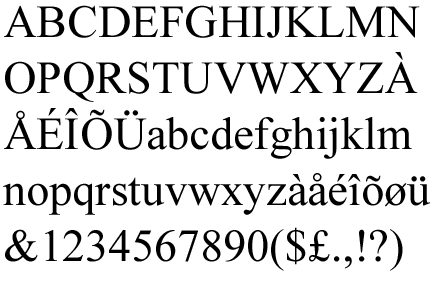
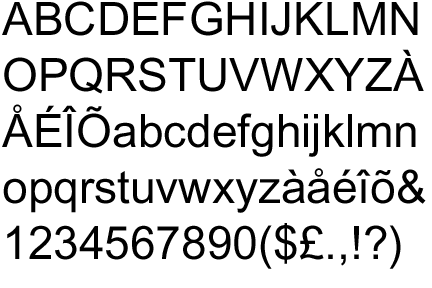
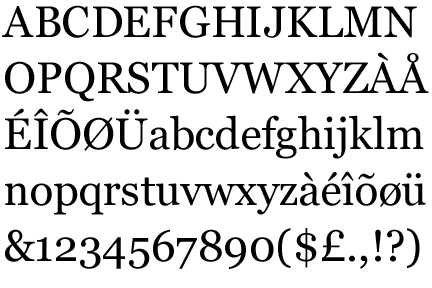
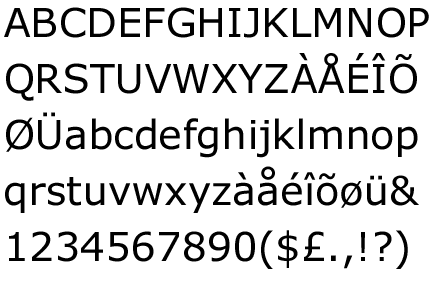
As an exercise, I practiced writing some of the different web safe typefaces with my colors. I also learned a little bit about each. Many of the sans serif fonts look the same hand drawn because the differences are quite subtle between them.






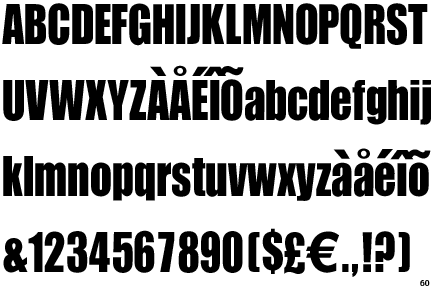

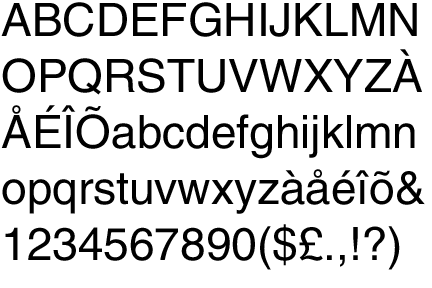

Drawing in my journal has made me develop an interest in design. After my first few attempts at noting things down, I realized my pages were such a mess, I couldn't comprehend anything. So, I decided to learn some things about graphic design so I could lay out my thoughts and write with different typefaces.
Typefaces all begin with a pencil and ruler. Then they are scanned into a computer system and digitized. What I like to do is take these digitized fonts and replicate them back on paper. I like the way they look imperfect, but at the same time, very clean.
As an exercise, I practiced writing some of the different web safe typefaces with my colors. I also learned a little bit about each. Many of the sans serif fonts look the same hand drawn because the differences are quite subtle between them.
Times New Roman
The Times New Roman typeface is a Serif type face. That means it has a small line (called a serif) attached to different letters. The font was created in 1931 for a British newspaper called The Times after a designer wrote an article criticizing the print and typography of the newspaper. They did a pretty good job of fixing the issue, because Times New Roman is the basis for most serif fonts in existence.
Arial
If Times New Roman is the basic serif, then Arial is the basic sans serif. It's used everywhere and it has 20+ variants. The typeface was created in 1982.
Georgia
Georgia is another serif font that's similar to Times New Roman. It was designed in 1993 as a more readable serif font, released as a companion to the font Verdana.
Verdana
Verdana is a humanist sans serif font. Sans serif means it does not contain those tiny lines. Humanist means it is meant to look calligraphic. It was also created to look good on a computer screen.
Trebuchet
Trebuchet (pronounced either tre-bu-shet or tre-bu-shay) is another humanist sans serif typeface commissioned by Microsoft to look good on computer screens.
Courier
Courier is a monospaced slab serif. Monospaced means each letter and character occupies the same amount of width. Slab serif means the serifs are thick and blocklike. This font was created in 1955 to replicate the look of a typewriter.
Impact
Impact is a realist sans serif that has thick strokes and compressed spacing in order to create an "impact." It's used frequently in internet memes.
Helvetica
Helvetica has an interesting history, because it wasn't simply created for computers like many of the other web safe fonts. The typeface was developed in 1957 as part of the International Typographic Style (or Swiss Style) movement in graphic design. The font is a basic sans serif, but it has a tinge more flavor than Arial.
Thursday, April 3, 2014
Journaling
A week ago or so, Tim gave me a set of 12 water color pencils and a notebook as a thank you gift for helping him with his teacher evaluations. I took the gift to heart and I decided it was time for me to bring out my art side.
Since then, I've been drawing a surprising amount.
I started by trying to draw simple things, like flowers and frogs. The results were pretty decent.


Since then, I've been drawing a surprising amount.
I started by trying to draw simple things, like flowers and frogs. The results were pretty decent.
When Luke saw some of my work, he suggested that I create an "everything" journal. Essentially, it's a journal that includes text and images.
I figured it was worth a shot. Notebooking is something that I've been considering for a while. I'm the kind of person that tries to do an insane amount of things simultaneously, and I find that a lot of the things I learn come in one ear and out the other. For me, the best way to remember things is to write them down, but I figure it's best to not write a blog post about every little thing I do in order to remember it. Perhaps that's more of a personal endeavor.
So I gave it a try. The first day I took random notes on things throughout the day, and I attempted to draw the portrait of Vladimir Nabokov on the back cover of my copy of Lolita.
The first thing I learned in this process: DO NOT USE PENCIL. IT SMUDGES LIKE CRAZY.
After that, I began noting in blue pen, although I continued to draw some more portraits in pencil.
I did this for a few days, but I noticed that my complex thought process could not be coherently expressed through the lists. Additionally, my ghastly handwriting gave me headaches.
My first thought was to learn something about design. To me, design is about turning chaos into coherence. It's about taking the complexity of the world and converting it into a form that can be tangibly digested.
So I googled some blogs, browsed until my computer gave me another headache, and put my pen to the paper. Though I was inspired by many of the images I saw, the one I stole from the most was a book about flatting written by New Zealander Lauren Earl.
The results were immediately evident.
I quite like making art because it helps me clear my mind. As you could imagine, I have a huge tendency to think too much for my own good. Art gives me relief from that.
My main concern now is with materials. Right now I'm using a slightly thicker than average blue pen on a basic sketchbook. Should I use a higher art quality pen so I have more drawing capabilites? Should I be using paper that doesn't seep through? Where do I even start looking for those things? I don't know jacksquat about art materials.
Thankfully, I'm in no rush.
Wednesday, March 26, 2014
The Current World of Writing
Recently I've realized that if I want to write more, I ought to read more. This may be obvious, but let me expand. What I believe is that it is not enough to simply read classics of the past, no matter how good they may be. It is also necessary to follow the literary world of the present, much of which exists in blogs, magazines, and newspapers.
I've spent the past hour or so browsing for random, interesting blogs, preferably idea and literary based though not necessarily. Based on what I've observed, I've come to one main conclusion.
Most writing is distributed through popular blogs, newspapers, and magazines. On the other hand, most writers have their own independent blog as their base.
That is, a writer will make articles for popular media as a way of gaining notoriety, but also maintain his or her own personal projects which have their own smaller but personal following.
This makes a lot of sense.
From this, I surmise that there are two types of modern-day writers. The first are active journalists who maintain these popular outlets. The second are passive writers who work on their own terms but rely on these outlets to access an audience.
Right now, I am working in a limited version of the second category. I am working for myself, but I am not seeking notoriety at this time.
If I do attempt a journalism major, I could end up in the first category, or stay in the second. It all depends on what I want to do.
I hope to read some more popular-ish blogs just for kicks, and if I enjoy them a lot, maybe I'll consider writing for them one day. Going to NYU, that could be a legitimate possibility for me.
Still, I'm not sure if that's what I would want to dedicate myself to, because I feel that I would want a vocation that actively helps make the world a better place. I suppose I could write for an outlet that does just that. It's still too early to predict anything though.
There are many doors. There are many options. Right now, I'm just taking everything one piece at a time.
Tuesday, March 18, 2014
Why I Make Art
Why I Make Art
After reading the packet we got for our STAC homework, I figured the best way to create a response for why I make art was by brainstorming my random thoughts. This post is a collection of some of the best (and most amusing) reasons I make art.
After reading the packet we got for our STAC homework, I figured the best way to create a response for why I make art was by brainstorming my random thoughts. This post is a collection of some of the best (and most amusing) reasons I make art.
Sunday, March 16, 2014
Am I Overshadowing Myself?
I know I post a pretty obnoxious amount, and I've probably lost the following of the little audience I had because of the high influx. I'm somewhat conflicted about this. On the one hand, I write my blog mainly for myself, to help me process things that I see, to take notes, and to act as a grading mechanism for STAC. On the other hand, I sometimes have well thought out discussions on my blog, and I wish I could engage more people with me, or help them through my insights. Another issue, should I really be writing public posts purely for myself? If that's my goal, shouldn't I just maintain a journal with my notes instead?
When I first started blogging, most of my posts would be under my current category of "Thoughts." I would have some thoughts about an abstract concept, and I would write in order to understand it better. I had a number of fairly intelligent insights, even when I was just fourteen. Writing was my tool for understanding the world in concrete terms. It was also my way of sharing my understandings so people could comment and learn.
My current writing practice lacks this type of writing. It predominantly exists as a form of gentle amusement. I don't necessarily have a problem with that. However, it does mean that my "thoughts" posts are playing a lesser role than they used to, which is saddening.
Perhaps a simple solution would be to add my thoughts posts to my predominant blog, and keep my library and journey posts here. That is something I am considering, but I'm not so confident in my thoughts posts that I want to share them widely. I feel that I talk about a lot of subjects I don't necessarily have validity on beyond my own personal experience. I don't want to be one of those people who acts like they have the whole world figured out but lacks even a basic sense of how the world works. I don't want to make statements on the pretense like I know what I'm saying when I don't. Are statements valid when they cannot be empirically proven? Are thoughts interesting when they are not hidden under the pretense of creative writing?
While I think many of my insights are true, I don't know if they are necessarily different from what a lot of people say. What makes my thoughts worth more? I could argue that the pure act of writing my thoughts automatically rises me above the level of those who don't even make the effort. Why should people care? Perhaps it doesn't matter why. If they do, then that is good. If they don't, I do something else.
What a hypocrite I am. I want people to read my thoughts, but I don't want them to, and this happens simultaneously.
I don't plan on changing too much yet, but I'm going to do one thing on this STAC blog. Instead of simply copying and pasting the posts from my 365 blog, I'm simply going to talk about the process for each post. This is mainly to appease the requirement of intellectual involvement and artistic continuum for our new assignment. These posts can be passed over easily, while the main focus can return to my thoughts. Maybe I'll do more later. We'll see.
When I first started blogging, most of my posts would be under my current category of "Thoughts." I would have some thoughts about an abstract concept, and I would write in order to understand it better. I had a number of fairly intelligent insights, even when I was just fourteen. Writing was my tool for understanding the world in concrete terms. It was also my way of sharing my understandings so people could comment and learn.
My current writing practice lacks this type of writing. It predominantly exists as a form of gentle amusement. I don't necessarily have a problem with that. However, it does mean that my "thoughts" posts are playing a lesser role than they used to, which is saddening.
Perhaps a simple solution would be to add my thoughts posts to my predominant blog, and keep my library and journey posts here. That is something I am considering, but I'm not so confident in my thoughts posts that I want to share them widely. I feel that I talk about a lot of subjects I don't necessarily have validity on beyond my own personal experience. I don't want to be one of those people who acts like they have the whole world figured out but lacks even a basic sense of how the world works. I don't want to make statements on the pretense like I know what I'm saying when I don't. Are statements valid when they cannot be empirically proven? Are thoughts interesting when they are not hidden under the pretense of creative writing?
While I think many of my insights are true, I don't know if they are necessarily different from what a lot of people say. What makes my thoughts worth more? I could argue that the pure act of writing my thoughts automatically rises me above the level of those who don't even make the effort. Why should people care? Perhaps it doesn't matter why. If they do, then that is good. If they don't, I do something else.
What a hypocrite I am. I want people to read my thoughts, but I don't want them to, and this happens simultaneously.
I don't plan on changing too much yet, but I'm going to do one thing on this STAC blog. Instead of simply copying and pasting the posts from my 365 blog, I'm simply going to talk about the process for each post. This is mainly to appease the requirement of intellectual involvement and artistic continuum for our new assignment. These posts can be passed over easily, while the main focus can return to my thoughts. Maybe I'll do more later. We'll see.
Saturday, March 8, 2014
My New Blog
For those of you who don't already know, I made a blog with the help of Luke. It's hot stuff.

As part of my artistic process, I would like to reflect upon a few things, but I shall do so in the form of brief statements.
On my blog
I've been wanting to make a strict writing blog since last year, and I'm glad I have finally done it.
On my URL
I came up with my URL spontaneously, but I have some concerns about it. Some may confuse the word "writes" with "rights" when it is spoken proverbially. Also, a friend of mine commented to me that "Ellen Rose" sounds a bit corny. I could see that. I wonder if it's worth doing something about.
On Wordpress
I don't know if I'm being antsy, but I find that Wordpress frequently loads much slower than sites like Blogspot. Perhaps this is because I use my own server instead of the server of a massive corporation.
On my layout
I like it a lot. The only issue I've been having has been trying to find a plugin that will give me a decent archive. I want to have my archive in calendar form, but the only plugin that did what I wanted looked like crap. So right now, my archive is simply in list form.
Additionally, I would like to change my favicon, but I don't know how.
On my portrait
I would like to take a better portrait of myself to use for my blog and other sources. I don't know when or how I'll be able to do this.
On promoting my blog
Everyday I've been telling myself "I'm gonna post my blog on my facebook once I get a really good post on the front page." Excuses. I've been too afraid of not seeming legitimate. I actually have grown the guts to tell a few people in person though.
On my Youtube
I updated the channel art, and I hope to add a description soon. My nerves for promoting my videos are the same as the ones of my blog.
On forming a community
I have a few other friends who write. I've been bugging them into updating their own blogs so that I can enjoy writing alongside them (instead of feeling the need to compete with them out of my own insecurity)
On talent
One of my friends who has been very supportive of my art told me that my blog showed that I was "talented." He claimed that my ability to post well everyday proved this. I don't know if writing daily is talent as much as it is discipline. But I'll take the compliment nonetheless.
On post-modern writing
In the world of the internet, I must admit that the long-form novel seems to be a diminishing form, at least at the moment. I see the future of writing in small, amusing snippets. That is how I like to write. The only issue is how to monetize it.
On my process
I usually follow the first idea I get for a shtick I can play with. I create many statements, and then I pick out the best ones. Somehow, I always have ideas. It's actually cool to sit in class sometimes and think "Later today, I will create something that I can't even conceive of at this very moment. But it will exist before the end of tonight."
On developing a library
It is a LOT easier for me to write when I'm basing my work off of something specific. For example, I read a book about Frida Kahlo, which inspired me to make some parody votive portraits based on her work and the descriptions I read. Easy to do, very funny. The more I write, the more I realize I must read in order to have material.
On maintaining my blog
Maintaining a blog is time consuming. I find myself running out of time daily trying to maintain the blog while keeping up with my high school responsibilities such as homework. I wish I could ease this process in some way but I don't know how. Perhaps I will not be able to post everyday, even though I will still write.
On posting my blogposts here
I don't know if it's redundant for me to post my blogposts on my STAC blog and my main blog. I know I have an audience here, so that's why I like to post here directly. On the other hand, I'm probably clogging up your blogfeeds way more than you expected, so maybe I should keep most things on my main blog.
On what's next
I don't know if I'll be able to complete an entire 365 because I don't know what my situation will be like in college. Also, I'm not 100% sure what I'm majoring in, but right now I'm considering a dual major in journalism and economics.
If this blog goes well, perhaps at the end of 4th quarter I will try to print some of the best posts, make a booklet, and sell it.
On why I want to have a completed project by the end of 4th quarter
When I was in 4th grade, I wrote an overdramatic story of how I snuck into my house to eat Doritos, from the point of view of a secret agent. When I shared this with the class, they hailed me as a writer. My teacher, Mrs. Talierchio, was very supportive of me as a student and she pushed me to keep writing. We developed a close bond. At the end of the year, she told me that she wanted a copy of my first book, and I never forgot.
In fact, I did give her the one and only copy of my first book when I graduated middle school. I wrote in 8th grade during the English Scholars Program. However, much of the book was haphazardly compiled together because I procrastinated so much, and I wasn't too proud of it. I told myself that when I graduated high school, I was going to give her another book, and it was going to be even better.
While my desire to write a book of some sort is related to overshadowing my album, it is also the desire to fulfill a promise I made to myself as a young child in various phases of my life.
So we'll just see what happens.
Subscribe to:
Posts (Atom)