Monday, December 31, 2012

The Amazing Adventures of Kavalier and Clay (The Inefficacy of the Imagination and Art)

For the past few weeks, I've been reading a book call The Amazing Adventures of Kavalier and Clay. The book proposed an interesting question that I haven't been able to stop thinking about.

The book is about two Jewish cousins who make comic books during World War 2. Sammy Clay is Brooklyn born, and Kavalier is an expatriate from Czechoslovakia. Although he was able to escape from Nazi Europe, the rest of his family remains trapped. He and his cousin create a comic book character called The Escapist, a man who can escape from any trap. He fights to free trapped people around the world, and the story is an obvious allegory for the European conflict.
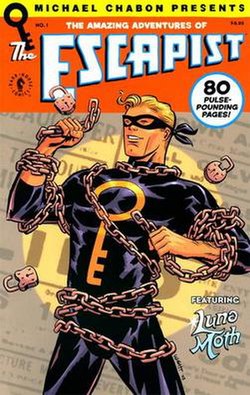

Joe becomes obsessive over his metaphorical fight against the Nazis via art, but he struggles with the fact that no matter how much the "Razis" are beaten up in his comic books, the real conflict remains the same. He gets into fights with all of the Germans he sees because he feels powerless. He chains himself to his drawing desk and becomes obsessive over his work, not allowing any time for pleasure.

Eventually, he gets a bomb threat, and his publishing company wants him to stop metaphorically beating up Nazis. His cynical editor George Deasey tells him this.

"This kind of work is a graveyard for every kind of ambition, Kavalier. Take my word for it. Whatever you hope to accomplish, whether from the art of out of...other considerations, you will fail. I have very little faith in the power of art, but I remember the flavor of that faith, if you will, from when I was I was your age...But this. Powerless. Useless."

This caught my attention. I've heard quite a lot of art as salvation against the world, but I never heard of money as a salvation against art. How does artistic expression become detrimental? Isn't the corporation the evil part? But if you think about it, the concrete corporation can give you more sanity than art.

It's probably a habit of a majority of artists to create an imaginary world in which they are victorious, or important in some way. Visual artists can literally create the image of whatever they please. Other forms of art can warp the world as desired. One of my definitions of art is that art is a metaphor to reality. It is not reality itself. It is a re-imagining of what already exists.

It's nice to live in your imagination. But there's always one trap that all people fall into. Your imagination is not real. Everything you envision in your head does not exist. It is a lie, and you can't live inside of it forever.

There is a need of all people to have some sense of reality, even if they thrive in a metaphysical world. This is because you cannot fully live inside of your imagination. There is always something to pop the bubble, and when it pops, you suddenly realize how bad your reality is. Though you can run away and hide in your bubble again, there will always be forces that remove you from that safe space, because that's what always happens. Though Joe Kavalier could live in his bubble for a while, he couldn't hide when his publisher gave him the ultimatum of ending his fictitious war against the Nazis or losing his job.

To a certain extent, everyone lives in their own version of reality that's adapted to what they want to see and observe. In order to cope with the fact that we are menial beings in the scope of the universe, we feel the need to develop an individual outlook on the world. In order to avoid pain, we create a construct in which we avoid all things we perceive as harmful. When this idea of reality is destroyed, we believe that the world is working against us. This is not the case. Just because things don't go your way doesn't mean the world is to blame. Your mind cannot control the world, but you can control your mind into thinking it can. It won't help you much.

I believe that every kind of emotional breakdown people experience stems from one thing, and one thing only: Reality letting down personal expectations. You can run, but the longer you have expectations, the more you end up frustrated, disappointed, and powerless. 

I wonder though, can a person be an artist if they don't live off of expectations? If Joe didn't feel the need to metaphorically defeat the Nazis, could he make comic books? Most artists come from difficult backgrounds. They use art as a coping mechanism for their powerlessness in the world. Though art does make a good distraction, is art actually an effective coping mechanism, or does it lift you up into a fantasy world, making it a harder fall when you tumble back into existence? Perhaps, but on the hand, it's probably fine in balanced doses. Xanax relieves pain, which is good, but if you use too much you die, which is bad.

Joe Kavalier stopped being obsessive when he got a girlfriend and his life became more hopeful. Though he continued to battle the Nazis, he created other comic book characters that had no relevance to the Nazi conflict. He worked less, and started living a more normal life.

So from all of this, I suppose there are a few things I can conclude. Art is a way of accomplishing your expectations of the world in some concrete form. However, art is not reality. Artistic expression is a coping mechanism for the disappointment that stems from the failure to achieve your expectations, with varying levels of success. If you take art too literally though, and get confused between imagination and reality, you can plunge into insanity.

Perhaps this is why artists are such broken people. And perhaps this is why I've had so much trouble finding the desire to make art, because I don't have problems like I used to. At least not dire ones. At the moment.

Wednesday, December 26, 2012

The Untethered Soul


First of all, I have to say that never in my life would I ever imagine myself reading any sort of self-help book, especially one dealing with spirituality. All throughout my life I dismissed such work as false, useless junk that is only read by stay-at-home moms in upperclass households trying to find meaning out of their empty lives. I mean, that's what Oprah and Martha Stewart and all those other people do.

Regardless, The Enneagram and other forms of spiritual self-analysis have always been a secret passion of mine. I am susceptible to searching for spiritual connections outside of mainstream religion, probably because I was raised in an atheist household and I always wondered if there was more to life than meets the eye.

God, I can't believe I'm even saying this. I can't believe I read a spiritual self-help book and it actually helped. It is completely outside my character, my lifestyle, and my beliefs to even acknowledge something greater than what I see in front of me. But sometimes, things take a turn for the unexpected, and I'm going to try my best to explain the book and spirituality as I understand it.

Who are you?

One topic the book delved into was this question. Now, there are many ways a person can answer this question, and it is likely all of the questions they will give are wrong. Perhaps a person could say,

Who are you?
I am Ellen Cooper.

But no, I am not Ellen Cooper, at least I am not just Ellen Cooper. The phrase I use to identify myself is nothing but a collection of letters that reads out phonics into a pronounceable word. If my name wasn't Ellen, would I cease to exist?

Who are you?
I am a junior at Herricks High School. I live on Long Island with my family. I performed on the accordion for my school's musical last year. 

No, this isn't who I am either. These are things that have happened in my life, but that doesn't mean that is who I am. Your life is not defined by the events that have happened to you. I did perform in Fiddler on the Roof, but that is not happening to me right now, so is that who I am?

Who are you?
I think, therefore I am.

A lovely quite from Descartes, but wrong again. You are not your thoughts. You simply observe your thoughts.

Who am I?

You are not the objects in your life, or what you observe around you. You are not your thoughts. You are not your emotions. You are the observer who sees these things.

What does this mean? It means that everything you define yourself by is arbitrary. You are not a person. You are an essence who is aware of the things around them. It's a strange concept. Let me try to explain this further.

You're at a party, and someone tells you, "You're ugly." You think, "I'm angry because this person just insulted me." But that is not true. You feel angry. This feeling is not a part of you, it is simply observed by you. A feeling is nothing more than a sensation that enters your body. This sensation can leave, if you identify its cause, justify it, and then release it from you.

First, you realize, "I feel angry." Why do you feel angry? "Because I've been insulted." Why does this insult affect you? "Because I feel somewhat self-conscious about my appearance." Why? "Because I feel like I'm unattractive." Why? "Because Larry made fun of my nose in the 7th grade and I still feel self-conscious about it."

This is letting yourself be defined by events. Perhaps Larry did make fun of your nose, but that was years ago. Why should you still care? It makes no logical sense for you to care. What if you just decided you didn't care? What if you said, "I like my nose because it's mine and because it's human."

Now, let's rewind. If you are ok with your nose, you don't feel unattractive. If you don't feel unattractive, you feel attractive. If you feel attractive, then what does one person calling you ugly matter? There are 6 billion people on this planet. If one of them has a problem with you, it shouldn't matter, logically. 

In fact, perhaps this person only called you ugly because they feel ugly. If that's the case, you shouldn't be angry. You should feel bad for them for having to put someone else down, and hope that one day they will decide to live a happier life.

And now that you have gone through this process, you can let it go. It happened, and it is gone. It doesn't matter.

The voice inside your head

You're trying to sleep, but you're having one of those nights where your mind can't stop thinking. You're thoughts go like this.

"Did I pass my chemistry test? I hope I passed my chemistry test? I studied so much. If I do badly my parents will be so upset with me. It will drop my grade. Oh I'm so worried?"

Let's think about this logically. There is nothing you can do to change your chemistry grade. Once the test is taken, it is taken. Your score will be returned to you and that is that. Your thoughts don't change the outcome. They are a useless waste of time that bother you and hinder you.

Let's explore this further. You're going on a walk, and in order to entertain yourself you narrate your life around you.

"What a pretty house. I love the pink and purple color. Oh, look at that dog! It looks just like my dog Rufus. That flower is delightful. I think it's a daisy."

Why do you narrate yourself? You can see the house, the flowers, and the dog. Is there a need for you to point these things out? Your mind automatically analyzes so many objects around you. If you stopped wasting time trying to pick out items from your vision, you will observe so much more of the outside world.

Doesn't this voice get annoying after a while? Imagine if the voice in your head was a real person, with all of its doubt, panic, and incessant talking. You would HATE that person! So why do you put up with it? What if you were to just stop? What if you just let the voice go?

Letting Go

Your life becomes exponentially more simple if you just let things go. People keep the burdens of their past events, failures, and future worries on their back. They hold onto these things because they feel as if they must have something concrete to define themselves by. Everyone holds these burdens. They hide them and pretend they don't exist, and instead of dealing with their problems, they simply find more ways to cover them up.

Think about it like a thorn. The pains we carry are like thorns in our body. There are two options. You can cover up the thorn and find ways to deal with it, without removing it. This appeals to most people, because removing the thorn of psychological pain is a difficult and painful process. But it's not productive on the long run. If you really want to free yourself of the burdon, you must remove the thorn, and let it go.

The world forgives you

If there is really a god out there, observing us from the heavens, do you think that he will hold your petty flaws against you? Of course not! A person who observes sees that the world is beautiful, with all of its flaws. An observer doesn't care what is happening so long as something is happening. Everything is incredible to them, and nothing can ruin that.

So whatever you have done, you are forgiven. And whatever you may do, you are also forgiven. You will always be forgiven, because in the scope of the whole world, what you do doesn't matter all that much.

Being an observer

People always complain about how much they hate their lives, and how much they hate the world. This is simply because the world does not fit the expectations that they generate for themselves in their head. The world does not work in a way that is predictable to them, and because of that, they fear the world, and they hide themselves from reality.

If you have no expectations, you cannot be disappointed. You will see that everything around you is incredible. The miraculous system that holds everything together is complex and beautiful. Everyday is a miracle. Every day you're alive and living is a miracle. We can die at any moment. What a great way to appreciate life around us to realize that it can always be taken away.

How this relates to every religion ever

You may think after reading this that what I say reminds you of a certain religion. Freeing yourself of desire is quite Buddhist. Forgiving yourself for inevitable sin is a very Christian concept. But if you look closely, you will see that despite all of the conflicts that take place between religions, they are all essentially they same thing. The thing that religion connects you to is difficult to put into words. That's why there are so many interpretations with their own nuances and technicalities. There is an energy that connects everything, and we feel it if we choose to remove ourselves from our complex human intricacies.

That is the best way I can describe my thoughts at the moment. I hope that was somewhat coherent. I did base much of what I wrote from the book.

Wednesday, December 19, 2012

Workshop: Songwriting with Brian

Brian began the work by introducing himself and what he does. What fascinated me was the way he talked about his passion for teaching. Basically, he said that as we grow older, we acquire knowledge, and it is our responsibility to pass on that knowledge and pass on that legacy. He talked about one of his most precious teachers, an 80 year old man who came out of retirement because he was so passionate about his job. Brian met with this teacher for half an hour every week. I don't know why, but this captivated me. I once believed being a teacher is what someone did when they gave up on their chance on a personal career, but what I see now is that being a teacher is creating a legacy for yourself, making you live on beyond yourself. It's admirable. It's beautiful.

Perhaps I should talk more about the songwriting, considering how that's what the workshop was really about. Brian outlined the music business. This is the breakdown of a record, from what I can remember, and what I can piece together with my late night mental mush.

49% for the songwriter/songwriters
26% for the record company
20% for the music distributor (the store)
4% for you
(give or take a few percentage points)

Now, let's consider you're given a contract for $1,000,000. First of all, a contract is a loan, not a gift. You have to pay it back. This is how the contract is divided.

$700,000 for recording an album/studio time
$300,000 for the manager

As you can see, you're only getting $700,000 to make the record, but you STILL have to pay back all $1,000,000. And you don't make a single cent off your CD until you do that.

So factor 4% of album profit into paying back $1,000,000 in debt. It's fucking ridiculous. I wanted to ask how illegal downloads factor into the situation, but I didn't quite get the chance. On the other hand, most of this stuff doesn't matter, because a lot of people produce out of their basements and promote themselves.

We heard some of Brian's songs as well. He's currently in the process of creating a musical about vampires and Mexicans in motor bikes. I think most of us were relieved by how our own personal songs were not the feature of the workshop. I know for me, I wrote mine 2 days before.

But of course we did end up presenting our songs, and I went first because I like taking initiative. Brian didn't say much in particular about my song, but he recommended to all of us that we try to write a song daily. He showed us some of the songs he wrote on his computer, and he had a total of around 80.

During the workshop, I started having this strange feeling where everything started fixing into place. Suddenly, it all made sense, it didn't seem so scary and complicated. When Brian played his songs I knew his process. When Brian talked about daily practice, I understood that the reason people don't do things is not because of a lack of time, but instead, a lack of making time and having discipline.

I wouldn't say I felt strongly motivated to write more music, but I did think it was a worthwhile workshop and I thought Brian was a great guy.

On the other hand, I am almost done with my notebook, which is quite a milestone. I've been using the same notebook since I first began writing songs back in 9th grade, and now I only have one page left. I may just tear it out so I don't have to feel the pressure of making a worthwhile song to complete my set. In fact, I'm going to do that right now.

*throws away paper*

I can now say that I have finished my first notebook. Wow! This is such a milestone!

Monday, December 17, 2012

Inner Voices: Log

I will admit, John and I had the goal in mind today that we would complete the music for the opera/R&B musical delight. I will admit, we did not accomplish anything.

I want to take a moment and analyze the artistic process that I have used thus far in the project to see where and what I should be doing next.

When Luke gave me the script for the opera, I took it with bold optimism. Without any kind of preconceptions, I wrote the music. Having Anika and Danny with me was a huge help. What happened was that I would play a few chords, Anika and Danny would improvise a vocal line, and then I would record the line. I have a collection of recordings on my phone for each musical line. After about a period of work, we all needed to take a break, but we accomplished quite a lot. Almost half the script was composed.

Then Luke asked me if I could finish the opera at home. I attempted this, but I could not complete the opera. I got stuck, unable to think of vocal lines and chord progressions. I could write a few pieces, but I couldn't assemble something particularly coherent. My hope was that I would be able to bring the piece to school and attempt the same process as before.

After the whole STAC Live mess, the opera was temporarily forgotten, until today when John and I revisited the piece. I showed him the recordings on my phone, but they were of such mediocre quality as to be almost inaudible. I attempted to play the opera on the piano, but without practice I stumbled on notes and chords, so that didn't work out well either. The opera wasn't completely coherent when I tried to play it as a whole. John pointed this out to me, and I agreed but I felt as if the beginning of the opera should have sporadic voices because it plays upon the value of surprise.

Another thing John and I discussed was the direction of the scene. It seemed like it was just a date with some singing (but we can't say just!). It seemed as if the opera was a joke that could not be prolonged because it wasn't going towards any particular direction. That probably means we should make it short and sweet, because it is definitely a funny shtick.

There wasn't much else to say after that. I didn't really know how to move the session towards writing more music. It didn't come to me as easily as it did when I had Anika and Danny assisting me. I was so uncertain, I ended up in a trap where I didn't much know why I was even doing anything at all. John asked me, "Do you want to keep the music you wrote? Do you want to rewrite this? Do you want to keep working on this?" I didn't have much of an answer to offer. It's probably my fault that we ended up being unproductive today because I couldn't make any definitive decisions. I had this hope that everything would be figured out tomorrow, and I spent the rest of the period dozing off.

Hopefully tomorrow we will be able to write music more effectively. I suggested to John that we have the singers assist in the composition process, but he's not sure if it's a good idea to get more people involved. We'll figure it out. Maybe.

Thursday, December 13, 2012

Music as Languages (And Other Cultural Debates)

As some of you may know, I've been taking Human Geography in school, and it's changed my outlook on everything. Geography has to do with everything. It explains history, it explains politics, it explains culture. Whether it's the lack of cultural diffusion due to large mountains, or the border disputes in Africa, or the psychological effects of the sizes of countries on a map, if the reason for an event taking place is unclear, it is often either geographically or culturally related. That being said, I'm going to talk about languages and it's not going to involve much geography.

The other night, I was reflecting on the experience that I had writing a song for Brian's workshop. Even though the workshop never took place (perhaps we will experience it later), I viewed my project as a learning experience, as I view virtually all events in my life. One thing I noticed when I was writing is that I felt like my music had no basis. As in, I was working from scratch. I had no intentional musical style, no framework, and no purpose. It wasn't very good in my opinion, and that's probably why.

I pondered this for a while. For centuries, musicians have been working off the music of their ancestors, developing techniques and traditions that created a more complex system over time. All of these music genres have a framework. This may be a somewhat prejudice statement, but I feel as if much of pop music has no structure. Either that, or it's structure is very simple, based only on chord progressions and theoretical musical ideas.

Then I realized, perhaps music is similar to language, which I've been learning a lot about in Human Geography. There are two types of languages. Natural Language is defined as a language that has emerged and evolved within living or historic human communities. A language is a complex system that develops overtime, based on the needs of a group of people. Words in some languages do not exist in others, like Farpotchket, the Yiddish word that means "to make something worse when you were trying to fix it." Languages can also be diffused, so some languages contain similar words to others.

There are also Artificial Languages, although they are not very common. An artificial language is one that is invented by humans and did not arise organically. For example, J. R. R. Tolken invented Elvish for his Lord of the Rings trilogy. Also, there was once an attempt to create an international language, with simplified grammar and common vocabulary from many languages. This is known as Esperanto.

Another thing to note about culture is the difference between Folk Culture and Popular Culture. Folk culture can be summarized as the local culture of a small area, based in traditions that have logical justification but no identifiable origin. Popular culture is widespread, mainstream culture, where phenomenas are spread without much purpose other than widespread appeal.

I feel as if you could categorize music as a language under these terms, folk music could be considered natural while pop music is artificial. In fact, perhaps much of modern art, rebooted in 1913, could be considered artificial. At that point, art stopped following traditions and began inventing a new set of rules and expectations which are constantly being expanded upon.

Now this may not be the case. That would assume that modern art and pop music are complete reinventions of what came before. And as we know, art is evolutionary, not revolutionary.

Another hypothesis I considered in the development of the language metaphor is perhaps pop music is a Pidgin Language. A pidgin language is one that "combines the vocabulary and/or grammatical practices from two or more languages that have come in contact." That would imply that pop music is a simplified mix of everything. A great example of a pidgin language is our own language, English. It incorporates aspects of French and Germanic language, simplified of their complex grammatical structures.

I don't know much about the history of modern pop music, but one would believe that it emerged from a few genres, such as blues, jazz, and before that, other things. Now, it has become it's own genre. This could be considered a Creole Language, "a language that develops from a pidgin language and is taught as a first language."

Of course I'm using pop in a very broad sense. There are many subgenres, but in a way, they all have great similarities. Perhaps we could consider rock, metal, generic pop, and alternative different kinds of Dialects, or "A variety of a language characterized by distinctive vocabulary, grammar, and/or pronunciation."

I believe if we can't see our art in the larger system, it will be empty and devoid of meaning. In the scope of the world, one person is not important. Great cultures are not invented by one person. That is, unless you're Tolken or J.K. Rowling. Even so, isn't it scary to think that only one person can invent a universe used by many? What I mean to say is, we should study the past and reuse what has been used for generations, joining in the cycle of life and the universe instead of working from ourselves as our only source.

My favorite pop music is often rooted in folk culture, whether it's the Beatles or crossover Balkan. To me, a lot of pop music is dull and insipid, and I feel like what I've explained above is one of the main reasons why.

On that note, I think it's time for me to return to one of the books I happen to be reading at the moment, "Music in Ireland."

The perks of having a musicologist mom, this stuff is great!

Friday, December 7, 2012

STAC Wall Faces

When brainstorming ideas for the wall faces, I imagined having a bunch of self-portraits where I cover my face with things like toilet paper, saran wrap, and paper bags. Then I asked myself, "If I put a plastic bag over my face, how will I breathe?" In response, I decided to take pictures with my mouth showing, thinking that it would look utterly gruesome and cool at the same time, and prevent me from dying. To make the mouth look more prominent, I colored the lips and tongue while keeping the rest of the image black and white. 

The biggest problem I had while taking the pictures was making sure that my head was centered in the right spot. I put the camera on a tripod and pointed it at the wall, but I couldn't figure out where to stand in order to be center shot. Obviously I couldn't look through the lens. In the end, I just decided to mark the center with a pencil. Hopefully it will erase. Right?

I also had a bit of a problem navigating the scene with my eyes covered. The walk between the spot where I covered my face to where I needed to take a picture was quite the adventure. I stuck my arms out and stepped around very slowly, hoping I wouldn't trip over my dad's boardgames or knock anything over. Perhaps there is a better way I could've approached this. Maybe I should've tried getting help, but it is what it is.
Aluminum foil. This one's my favorite!
Toilet paper
Saran wrap. I'm not sure if my mouth looks too fake on this. Also, I'm not sure if it fits the theme because you can see my face. I must decide what to do with this.
Plastic bag
Gift wrap. My mom helped me on this one.
I want to do 8 images on this. So far, I have 5. I need to figure out what else I can use to cover my face.

Thursday, December 6, 2012

A Question to Danny About Color Theory

Here's one thing I never quite understood about RGB values on the computer. How come some colors are easier to find than others in a color field?

For example. if you want to choose purple, you have a pretty good selection of purples, all of which genuinely look purple.


Same for green.


For some reason though, it's really hard to find a decent orange.


Maybe I'm just being picky here, but to me the colors look darker and browner than orange. Even on the color slider on the side, the region for orange is considerably smaller than that for the other colors. Even yellow is more prominent, although it's pretty difficult to choose a decent yellow as well.


Now, it's very possible that I'm overanalyzing some colors over others. Perhaps it's difficult to find what could be considered a "true color" on any color field. If so, why is it so difficult? How come there are so many variations of a color that don't even resemble the color all that much?

Perhaps our minds are more adapted to the different kinds of greens as opposed to the different kinds of oranges. A color like green is very widespread. We see many variations of green in all sorts of plant life. We can look at a color that isn't even close to "true green" and think it's green. If we try the same thing with orange though, we may find it deviates more from our imagined "true orange." 

Today in class you were telling me about how we generally accept the color cyan as blue, even though it is not. Cyan, magenta, and yellow are part of a different set of primary colors. Yet, we assume cyan is blue and magenta is purple. At the same time, yellow is still considered yellow in all contexts.

Is this a misconception that stems from the way our brains compute the light absorbed through out eyes, or is it something psychological?

I don't know if these are questions you've already answered, but that's what I'm curious about.

Wednesday, December 5, 2012

The Women's Myth

I'm going to try my best to keep this post as little guerrilla feminist as possible. I promise!

Luke's discussion in school today brought forth a topic that I myself have pondered for years. He talked about the hero's myth, specifically the male myth. I wonder, why are almost all adventure based myths centered around males? Bulcsu in Kontroll, Luke Skywalker in Starwars, Alexandre Beck in Tell No One, Odysseus in the Odyssey, these are all male heroes. Even in Cloud Atlas, only two females were featured, and in their stories they had roles where they were largely assisted by men. That's not saying all hero myths are male, it's just that most of them are.

Now, why would I bother talking about something so obvious? Our society is patriarchal  there is always a tendency to prefer men in these kinds of things.

When I watched Cloud Atlas, I noticed something strange. My favorite plot line was the one in Neo Seoul. To sum it up quickly, the futuristic Korean society has created a set of drone-like clones who's only purpose is to serve food to customers at a New Seoul restaurant. These women are not allowed to be shown anything of the outside world, and they can be killed upon command if they disobey their masters. One of these clones, Somni-451, accidentally leaves her sleeping box, which puts her in grave danger. A man by the name of Hae-Joo Chang comes and rescues her. They fall in love, but it is brief, and she also leads a revolution for a while.

I feel like in all story-based art, we have a tendency to sympathize with the character that relates the most to us, and to put ourselves in their spot, as if we were the character. While watching this part of the movie, I found that I was not putting myself into the shoes of Hae-Joo Chang, the savior. I felt as if I was Somni-451, being rescued from a terrible life in order to lead a revolution.

It makes sense. We always relate more to people who are similar to us, and often, people of our gender seem pretty similar to us.

This brings me to my main point. If all action films are patriarchal, what can girls relate to? When you watch an adventure movie, you're supposed to relate to the hero, regardless of gender. To a certain extent I do. But when I see the male hero's point of view on women, I see women as beautiful, precious objects that are admired for their charm and beauty. Thus, I deduce that a woman is a beautiful, precious object that's admired for its charm and beauty. Thus, I believe that I should be a beautiful, precious object that's admired for its charm and beauty, and that will bring me happiness in life.

All women's myths teach girls that exact moral. Sleeping Beauty waited for her prince to wake her up. So did Snow White. Cinderella was saved by her prince taking enough interest to search for her with his only relic, her shoe. Jasmine road on some carpets with Aladdin and that's all she had to do.

When watching Cloud Atlas, I thought not about all the revolutionary things Somni-451 was doing, but how awesome it would be to have a man just come and rescue me. I mean wouldn't that be great?

But there's one major flaw with the Female myth.

IT SUCKS

Sure, it's nice to ponder being rescued for mundanity, but in real life that doesn't give you much excitement. How much of Snow White's life did you hear about before she fell unconscious? Do you really want to hear Penelope talk about the agonizing 20 years she spent waiting for Odysseus? Which story is more interesting to read, "The Girl Who Fell in Love" or "The Girl Who's Waiting Really Patiently"? Actually, let me revise that. Would you rather hear about "The Girl Who Fell in Love" or "The Girl Who Went on a Quest and Fell in Love Along the Way"?

It's more interesting to be involved in the adventure. Does adventure need to be a male-centric thing?

If girls can only see an active life from the male point of view, they how are they supposed to apply the morals to their own lives without seeming like a man? People say a girl can do anything a man can do, but when girls do things like carrying heavy objects, working ambitiously to get ahead in a job, or proposing marriage, people thing it's weird. They don't believe it wrong, they just view it as unusual.

My question is simple. Is the Female Myth a dimwitted version of the general adventure myth?

Perhaps the Man's Myth actually the Human's Myth, something that is meant to be applicable to all people regardless of gender.

If that's the case then we should have more girls starring in mythic stories. We need better role models.