The book is about two Jewish cousins who make comic books during World War 2. Sammy Clay is Brooklyn born, and Kavalier is an expatriate from Czechoslovakia. Although he was able to escape from Nazi Europe, the rest of his family remains trapped. He and his cousin create a comic book character called The Escapist, a man who can escape from any trap. He fights to free trapped people around the world, and the story is an obvious allegory for the European conflict.
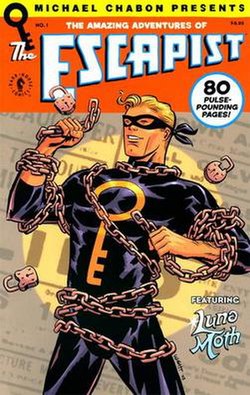
Joe becomes obsessive over his metaphorical fight against the Nazis via art, but he struggles with the fact that no matter how much the "Razis" are beaten up in his comic books, the real conflict remains the same. He gets into fights with all of the Germans he sees because he feels powerless. He chains himself to his drawing desk and becomes obsessive over his work, not allowing any time for pleasure.
Eventually, he gets a bomb threat, and his publishing company wants him to stop metaphorically beating up Nazis. His cynical editor George Deasey tells him this.
"This kind of work is a graveyard for every kind of ambition, Kavalier. Take my word for it. Whatever you hope to accomplish, whether from the art of out of...other considerations, you will fail. I have very little faith in the power of art, but I remember the flavor of that faith, if you will, from when I was I was your age...But this. Powerless. Useless."
This caught my attention. I've heard quite a lot of art as salvation against the world, but I never heard of money as a salvation against art. How does artistic expression become detrimental? Isn't the corporation the evil part? But if you think about it, the concrete corporation can give you more sanity than art.
It's probably a habit of a majority of artists to create an imaginary world in which they are victorious, or important in some way. Visual artists can literally create the image of whatever they please. Other forms of art can warp the world as desired. One of my definitions of art is that art is a metaphor to reality. It is not reality itself. It is a re-imagining of what already exists.
It's nice to live in your imagination. But there's always one trap that all people fall into. Your imagination is not real. Everything you envision in your head does not exist. It is a lie, and you can't live inside of it forever.
There is a need of all people to have some sense of reality, even if they thrive in a metaphysical world. This is because you cannot fully live inside of your imagination. There is always something to pop the bubble, and when it pops, you suddenly realize how bad your reality is. Though you can run away and hide in your bubble again, there will always be forces that remove you from that safe space, because that's what always happens. Though Joe Kavalier could live in his bubble for a while, he couldn't hide when his publisher gave him the ultimatum of ending his fictitious war against the Nazis or losing his job.
To a certain extent, everyone lives in their own version of reality that's adapted to what they want to see and observe. In order to cope with the fact that we are menial beings in the scope of the universe, we feel the need to develop an individual outlook on the world. In order to avoid pain, we create a construct in which we avoid all things we perceive as harmful. When this idea of reality is destroyed, we believe that the world is working against us. This is not the case. Just because things don't go your way doesn't mean the world is to blame. Your mind cannot control the world, but you can control your mind into thinking it can. It won't help you much.
I believe that every kind of emotional breakdown people experience stems from one thing, and one thing only: Reality letting down personal expectations. You can run, but the longer you have expectations, the more you end up frustrated, disappointed, and powerless.
I wonder though, can a person be an artist if they don't live off of expectations? If Joe didn't feel the need to metaphorically defeat the Nazis, could he make comic books? Most artists come from difficult backgrounds. They use art as a coping mechanism for their powerlessness in the world. Though art does make a good distraction, is art actually an effective coping mechanism, or does it lift you up into a fantasy world, making it a harder fall when you tumble back into existence? Perhaps, but on the hand, it's probably fine in balanced doses. Xanax relieves pain, which is good, but if you use too much you die, which is bad.
Joe Kavalier stopped being obsessive when he got a girlfriend and his life became more hopeful. Though he continued to battle the Nazis, he created other comic book characters that had no relevance to the Nazi conflict. He worked less, and started living a more normal life.
So from all of this, I suppose there are a few things I can conclude. Art is a way of accomplishing your expectations of the world in some concrete form. However, art is not reality. Artistic expression is a coping mechanism for the disappointment that stems from the failure to achieve your expectations, with varying levels of success. If you take art too literally though, and get confused between imagination and reality, you can plunge into insanity.
Perhaps this is why artists are such broken people. And perhaps this is why I've had so much trouble finding the desire to make art, because I don't have problems like I used to. At least not dire ones. At the moment.