Saturday, March 30, 2013

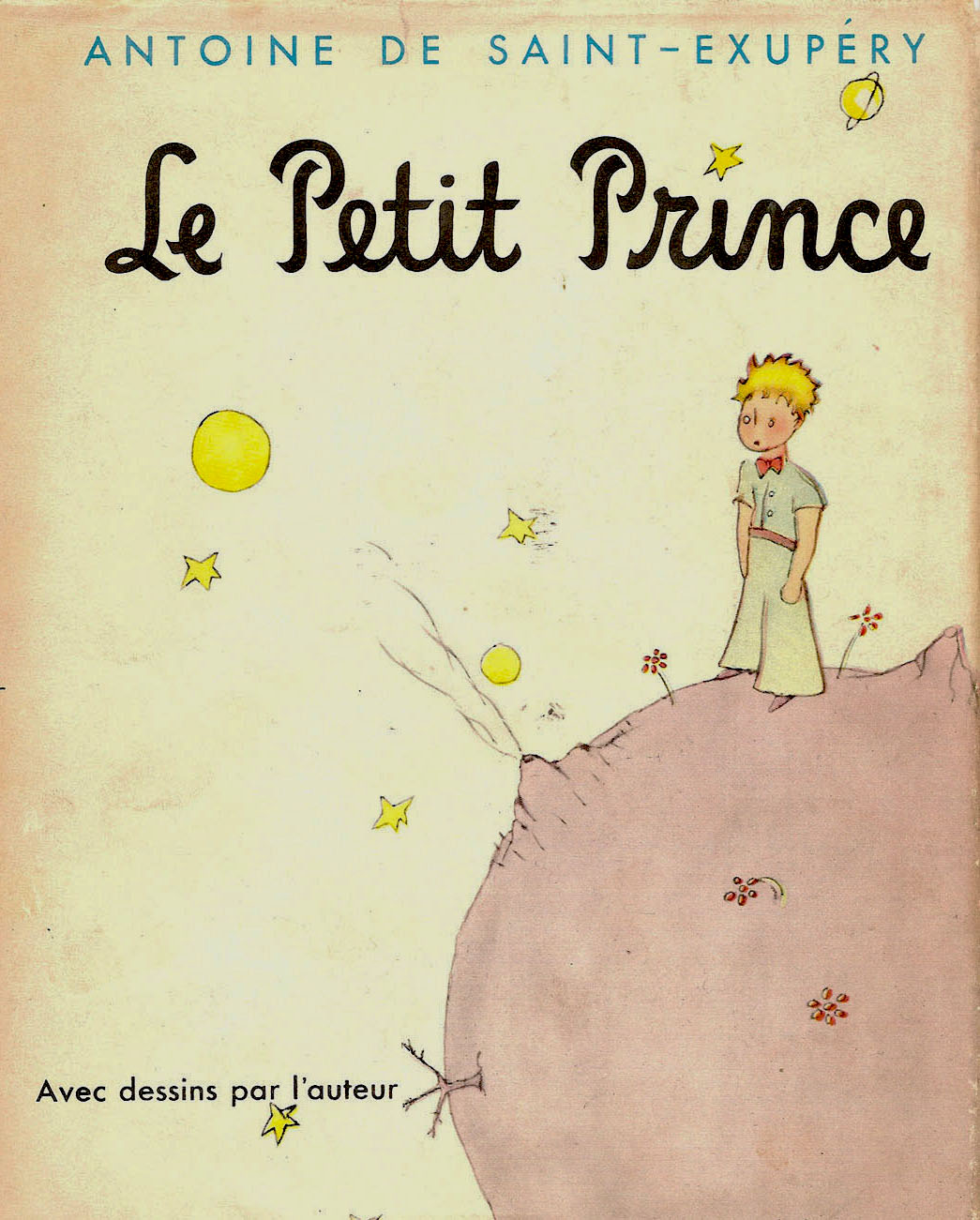
The Little Prince


I have been meaning to read The Little Prince ever since the tour guide on my trip to France recommended it to me and my classmates during my freshman year. I had the fantasy that I would magically learn enough French to read the book in its native language, but when I saw it sitting on the shelf at the Shelter Rock Library, I figured now was the time to read it. Perhaps one day I will learn how to read French. When that day comes, if it comes, I will read the book in its native language.

To call The Little Prince a children's book is a bit misleading. It's as much of a children's book as Animal Farm is. It can be understood by children, but it is primarily an allegory. While Animal Farm simplifies communism, The Little Prince simplifies life as we know it, and encourages us to question the purpose of our actions.

The story begins with an anecdote by the narrator describing the moment when his child imagination was ruined. When he was six years old, he read in a book about how a boa constructor devour and digest their prey. He drew a picture of a boa constructor with prey in its stomach, which he called Drawing Number One


Most people interpreted the image as a strange hat, so he decided to make a second image where the prey was clearly visible, which he called Drawing Number Two.
The reaction to the second picture was much more intense. Grown-ups told him to put his pictures of boa constructors away and pursue subjects like geography, history, arithmetics and grammar instead. The narrator pursued a proper adult life, but it was clear that he was dissatisfied with it, and he felt alien to the people around them.

He became an airline pilot, and one day while riding his personal plane by himself, he crashed into the Sahara desert where he met The Little Prince.

The Prince came from a small asteroid, where he was the only person living. His asteroid had two active volcanoes and one inactive volcano which he cleaned daily. In addition to cleaning volcanoes, he was also responsible for weeding out Baobab plants, because Baobabs grow into massive trees that completely engulf an asteroid planet.

Another important feature on his asteroid was a rose that he took great care of. The rose spoke and tended to be overly demanding.

One day the prince wanted to venture from his asteroid. Though he was sad to leave his dear rose, he wished to learn more about the world, so he went on a quest.

He visited various asteroids, each of which satirize various aspects of society. I found this section particularly interesting

Politics and Leadership

The first planet was inhabited by a king, who greets the Prince by saying "Here's a subject." The explanation: for kings, all men are subjects. The King speaks in a number of contradictory statements, stating that he would "tolerate no disobedience," but "all of his commands were reasonable." That is, he will command the stars, but he will only ask them to do what they have been doing already.

This describes governments quite well. Though people act as if they have power, this power mainly a conception created by the ruler.

Conceited People

The second planet was inhabited by a conceited man who ignores anything that isn't a compliment towards him. He asks The Prince to admire him, and call him the best man on his planet. The Prince notes that he is the only man that lives on his planet. The conceited man does not find this very important, and asks for appraisal anyhow. "I admire you," the prince said, "but what is there about my admiration that interests you so much?" 

The prince loves to ask questions, and though his questions are targeted towards the people he meets, they are also targeted towards us. Why do we seek admiration so much? What is the purpose?

Alcoholics

This was my personal favorite. The third planet was inhabited by a drunkard, who drank to forget that  he was ashamed of drinking.

I think the implications of this tale are obvious. Hypocrisy and inaction are rampant among members of humanity.

Business

The fourth planet is inhabited by a business man who has made it his business to count the stars in the sky, which he claims to own because nobody else has claimed them yet. The prince asks why he owns the stars. The businessman tell him that owning stars makes him rich. The prince asks why he wants to be rich. In order to buy more stars, he replies.

This mocks business and consumerist society. We spend so much time acquiring money, but rarely do we ask why.

Low-Class Workers

The fifth planet was inhabited by a lamplighter. His job was to light the lamp at sunrise and put it out at sunset. At first his job was simple because he only had to light the lamp occasionally. Unfortunately though, the planet's rotation speed increased, and now he had to go through the lighting cycle every two minutes. His orders never changed, and because he was always faithful to his orders, he was overworked.

Unlike the other planets the prince described, this was the first time he encountered someone he actually liked and admired. He was disappointed by the fact that he could do nothing to help the poor overworked man. Though I wouldn't say the book idolizes the low-wage worker, he definitely places a more positive emphasis on this character than the others. I suppose that's how many of us see low-wage workers. We want to help them, but we cannot, due to flaws in the system.

Academics

The sixth planet was inhabited by a geographer. The geographer was constantly mapping his planet, but he never stood up from his desk to examine the world around him. Instead, he requested explorers to do so for him, and he had a complex procedure in which he would evaluate the merit and accuracy of said explorers. The Prince told him about his own planet. He noted the volcanoes, but disregarded the flower as unimportant because it was ephemeral, which means "that which is threatened by imminent disappearance."The prince was not pleased with such disregard for his flower, for he viewed his flower as one of the main aspects of his asteroid.

This mocks how academics have good intentions, but often lose sight of important aspects by trying to sculpt an ideological bigger picture. It is obvious to the reader that the geographer should observe the planet himself, but, like many academics and statistical gatherers, he expects others to do it instead. In addition, the emotionally detached academic ignores important facts because they do not fit his standard of importance. The flower was very important to the prince, but the geographer ignored it because he did not think it was concrete enough. They view emotions as unimportant when in reality, emotions play a large impact in the world.

The World

After the prince visits the six planets, he comes to earth, tames a fox, and wanders around. We find out it is the anniversary of when he first arrived on earth and he decides it is time to leave. The narrator is sad to see him go but touched by the experience that he has had. I admit, I teared a little at this part. The prince leaves and the narrator continues his life.

I found this book very touching for a number of reasons. First of all, it reminded me of what it was like to be a child, before having my mind tricked into the system that we live in now. Children ask many questions, but adults, not as much. It was said throughout the book that the prince "never in his life let go of a question once he asked it." He asks obvious questions that we our too afraid to ask, for when we inquire as to the purpose of our action, we often discover that no purpose exists. Our expectations shatter, and we are left to pick of the pieces of what we perceived as reality.

I believe that while these shattering experiences can be traumatic, they are ultimately healthy. They are part of a necessary process that one must go through in order to become a fully wise, understanding, and independent individual. 

Too often we are lost in the details, when we should be seeing the world from a detached point of view. Recently, I have been reading a book called Timescale by Nigel Calder. The book is an attempt to chronologically organize the history of the earth and the universe. In the opening, the author talks about how many theories have been subordinated by scientific discoveries, and how academics often fear accepting the truth because the truth disproves their own research and hypotheses. For example, and this is something you may not know, Charles Darwin's theory of natural selection is not entirely accurate. Although some genetic adaptations are adopted because they give a species an advantage for survival, there is much evidence to show that many genetic adaptations are completely neutral. That is, they neither hurt nor help the organism, so they end up staying. Many Selectionists denied these theories because they did not fit their perfect idea of how organisms are perfectly crafted to be the best that they can be through survival. Science is always changing.


He then goes on to view the earth from the point of view of a Martian. He observes everything from a completely detached point of view, from governments to weather patterns to culture to migration. He notes that there is a clear tendency for the white man to be more rich and successful than the black man, which is likely what a martian would observe if they could only observe the planet visually from a distance. He describes how the wealthy manipulate other people into producing food for them by exchanging objects. This gave me a greater understanding of how the world worked in a manner that made sense. Without specific details, there is a clear system, and that system is clearly flawed in some ways.

So instead of getting lost in the facts, we should spend more time examining the bigger picture. Not only is it humbling to view the world from the point of view of a martian, but it is also enlightening. To question the system does not mean to destroy it. All it means is that we gain a better understanding so we can know how best to contribute to the system and to one another. It also prevents us from getting lost within the system, because when we lose ourselves in the system, we lose ourselves as people.

Bibliography

Calder, Nigel. Timescale. New York: Viking Press, 1983. Print. 
Saint-Exupéry, Antoine De. The Little Prince. Orlando: Harcourt, 1943. Print. 

Thursday, March 28, 2013

An Overhaul

I've been thinking and rethinking possible approaches to my blog. Overtime, it seems that my blog has changed, much like I have changed. It began with my meditations upon certain topics, continued into being a daily record of a large project, and has now become a combination of thoughts, records, and responses.

Now, I'm thinking I want to make my blog a record of the art I observe and the art I create.

I see almost everything that I do as a project. Every book I read, every film or TV show I watch, every piece of art that I make, these are all projects for me. I keep these all in a mental record in my head, which can be overwhelming. What can I do to remember my thoughts for everything that I do?

After writing responses to the books that I read, such as The Untethered Soul and Let Your Life Speak, I realized that writing blog posts is a very effective way of retaining important information. Not only does it help me retain information, it also helps me process the information. It takes the abstract thoughts that I have in my head and places them into a concrete set of words that I can reference whenever I like. What a miraculous tool that is!

Clearly, this is something that I ought to do more. It definitely helps me, and it may help you guys as well.

The only issue is that I give myself MANY projects. I can make a list of all the things I have done so far this vacation alone

  • Watched The Passion of the Christ 
    • Because a few friends recommended I watch it in honor of Holy Week so I can learn about Christianity
  • Watched an episode of Sherlock Holmes 
    • Because British television is great
  • Finished a book about Irish folk music 
    • Because I started it two months ago and I never got the chance to finish it
  • Read The Little Prince 
    • Because I renewed my library card for the first time in 2 years and I saw it while browsing the teen lit section. I made a promise to myself that I would teach myself enough French to read it, but frankly, that wasn't going to happen anytime soon, so I figured I would read it now
  • Learned more Spanish 
    • Because I want to be bilingual and I have friends fluent in Spanish so why not?
  • Retaught myself how to knit 
    • Because I have trouble sitting still during television shows like Sherlock and I figured, why not watch TV and do something productive?
  • Cooked a tea recipe 
    • Because I love tea
  • Helped Danny make puppets for the puppet show
    • Because that is my project
  • Added more of my mom's CDs to my harddrive
    • Because I have an ongoing project to convert all of her CDs to digital
  • Watched Daniel Glover do standup
    • Because Julian showed it to me, and he's excellent in every way
  • Toured NYU and Columbia
    • Because soon I'm going to have to become an adult
I'm a finisher. I'm addicted to finishing things. I think this is a good addiction compared to most addictions. I don't watch TV for hours on end, I don't watch youtube videos. I collect culture. I want to watch all of the great movies, read all the great books, know all the great actors, understand history from the creation of the earth until now, speak a number of languages, and keep up good fashion. It sounds like much, but with my small projects, I'm conquering the world little by little.

I specifically plan out my projects in a way so that I never feel overwhelmed. Though I do many things, I limit myself within my, genres? For example, I will only read one or two books at a time, watch one or two movies a week (sometimes less), and listen to one or two new CDs a week.

I read an interesting article that Shiana posted for my English class. It said that people work most productively when they work in 90 minute intervals, followed by breaks. When I spend enough time on one project, I switch to another. This switch re-energizes me, and allows me to be active constantly. I love it. By the way, if you are more interested in the connection between sleep, work intervals, and productivity, you can read the article here.

Because I do so many things, I probably can't blog about them all, or else I will spend more time reflecting than doing, and I am a woman of action. At the same time, blogging will help me slow down, because if I don't exert self-control, I can spin out of control with insane projects. It's all about following The Way, staying on the tightrope, finding a middle ground. Thankfully, years of experience and active self-observance have greatly helped me exert this self-control. I'm doing well.

Some final notes on organization and appearance. A friend of mine gave me two recommendations. First of all, he told me I should get a new theme. I've actually have a lot of difficulty finding a decent Blogger theme that wasn't covered with sparkling skulls, or wasn't too HTML complex. I do have vague recollections of HTML knowledge from my Neopets days, but the most I can do it edit a toolbar and change a font.

Secondly, he told me I should use more pictures. I hadn't thought of using pictures much because I'm so focused on writing my thoughts, but pictures would probably make it easier for other people to read, and it will make the post more active.

Wednesday, March 20, 2013

Stitler Finale

Yesterday, I decided it was finally time to finish the Stitler project. I figured it would be easily and fun to complete, and I would end up with a quality product.

I must admit though, when I attempted the project again, I felt as if it had lost its luster. It wasn't as funny to me as it was before. I didn't acknowledge my feelings at the time because I did not want to be discouraged, and I didn't want to be negative. Danny and I downloaded a number of slow motion clips to add in between. I edited things together and tried to make the foreigner lyrics more in sync with the voices of Hitler and Stalin. After piecing a good amount of it together, Danny recommended that a change of song might uplift the project.

At that point, he had to leave for chorus, and he gave me the permission to do whatever I saw fit for the video. I used the song MacArthur's Park, because it is a silly romance song, and I thought it would uplift the video. Unfortunately, I think it made me even more unenthusiastic. Perhaps I had already heard the song so many times, it no longer seemed silly to me. On the bright side, the song had a number of instrumental sections, so the film was easy to compile.

Once I had pulled everything together into a generally cohesive video, I decided it was finished. I had completely lost all willingness to continue. It wasn't that I was angry. I was simply done. I had nothing else to add.

So does this project have added meaning? In the beginning I would have said yes, but at this point, I do not think so. I don't think there is anything profound about the video. In fact, I barely find it entertaining to watch. It is nothing more than random clips compiled with mediocre pop song lyrics. Where did the magic go? I'm not sure. It disappeared.

But at least it was fun while it lasted.


Sunday, March 17, 2013

Scholarly Review: Evita

Yesterday, after months of begging by a friend, I finally saw Evita. It taught me a good amount about society in South America. It also taught me there is a lot I will never understand about society in South America.

Plot

The film begins in a movie theater where a film is abruptly stopped with the announcement that Eva Perón has passed away. Everyone in the theater cries vigorously, and we watch the funeral proceedings. At this time we are introduced to our narrator, Ché, who is somewhat resemblant of Ché Guevara  but mainly acts as the human embodiment of Argentina. He has a neutral expression, and he claims that while many admire Evita, she actually hasn't accomplished much in her past few years.

We see Evita as a child. She is the bastard child of a poor woman and a rich man, and her father has just passed away. She, her siblings, and their mother are not allowed into the funeral because his family thinks they are scum. Despite this, she runs inside the church and kisses her father's forehead, bidding him a final goodbye before she is quickly thrown out. This experience made her despite the upper-classes.

Next, we Evita all grown up, as played by none other than Madonna. She is in an affair with a tango singer, Agustín Magaldi. One day, she tells him that she wants to go to the big apple, Buenos Aires. Magaldi is unable to change her mind, and he takes her there. He leaves her, and she decides that she will simply try to have as many affairs as possible in order to increase her leverage. She becomes a model, a radio personality, and an actor (albeit a very bad one).

She meets Colonel Juan Perón at a fundraising event. She easily seduces him, and they develop a powerful relationship. The upper-class people dislike her, and they believe Perón is a fool. She detests them in return. However, the people of Argentina love her for being one of them, and this gives Juan Perón serious political leverage. When he is taken as prisoner, she campaigns for his release, stating that "He supports you, for he loves you, understands you, is one of you. If not, how could he love me?" It works, and he is released. Soon he is elected as Argentina's next president. In the song "Don't Cry for Me Argentina," Eva preaches to the people of Argentina that she will serve the "descamisados," literally those without shirts, the poor. 

Eva dresses herself in luxury clothing such as Dior and goes on a "Rainbow Tour" across various countries in Europe, I suppose to promote Argentina. Spain loves her, Italy calls her a whore, and France is ambivalent, because at that point in the tour she seemed to become detached and apathetic. This was due to a sickness that worsens overtime.


She returns to Argentina and starts a charity organization. At the same time, the country is falling apart. Other Perónists plunder the treasury. Violent civilian demonstrations are suppressed brutally by the military.


Eva seriously considers running alongside her husband as a vice presidential candidate, but her sickness weakens her to the point where she resigns. At this point, she is very clearly dying, and she bids her people a final farewell with a reprise of "Don't Cry for Me Argentina." We enter a parallel universe where she dances a tango with the narrator Ché as he criticizes her. "How can you claim you're our savior when those who oppose you are stepped on, or cut up, or simply disappear?" She defends herself.


Lastly, we see her sick in bed, wishing her physical body was as strong as her heart and passion. She dies of cancer. The end calls back to the beginning, with Ché standing above her coffin, speaking some final words.

Reflections

In the United States, we do not have a rigid class structure Our country values hard work and social elevation. This is not true in a majority of places in the world, and I feel like it's difficult for Americans to understand that, myself certainly included. Living in Long Island suburbia, it is even more difficult. Because taxes are so high in our neighborhood, the only people that can afford to live here are of a similar socio-economic class. We live in a bubble. It's delightful to grow up in a bubble, but it won't give you a full understanding of how the world works.

This concept of socio-economic differences really started to make sense to me when Eva tried to visit her father during his funeral in the beginning of the film. His family treated her like utter filth. I've never seen people treated in that manner in my own life except for homeless in New York City. Perhaps I could get a better perspective if I imagined New York City with a LARGE population of homeless people.

I think casting Madonna as Eva was a very good choice, because her rise in society was quite similar to Eva's. Madonna grew up in Michigan, and one day she ran away to New York with nothing more than $35 in her pocket. It was then that she worked her way up in the music business and did all sorts of interesting things that I do not know much about.

One interesting thing my friend pointed out to me was Eva Perón's blatant hypocrisy. She claimed to be one of the people, but then she dressed in luxury clothing and toured around Europe. There is one song where Ché asks her, "Forgive my intrusion, but fine as those sentiments sound


Little has changed for us peasants down here on the ground

I hate to sound childish, ungrateful, I don't like to moan

But do you now represent anyone's cause but your own?"


Later, violence is still widespread. I got quite confused at this part, and I didn't quite know what was happening. First, there were clips of the Peróns with their puppies, next, buildings are being blown up. I believe this has to do with the ignorance of the Peróns to the condition of their country, but I'm not very sure.

I think the main point of the film was to communicate how much the poor have been ignored, and how much they admired this woman they believed spoke for their cause. It depicted a good amount of manipulation. Eva didn't do much other than look pretty and establish a charity and I don't even know how much efficacy her charity foundation had. I think her main accomplishment was finally representing the poor in an upper-class dominated society.

At the end of the musical, I asked myself, "What was accomplished?" To me this seemed very unclear. The musical left me wanting more, but I can't put my finger on exactly what that "more" is. 

Perhaps that is a reflection on the pointlessness on life. Why do we try to succeed? Why do we search for elevation? What makes the world a better place? Though Eva rose quickly in society, she never had an end goal. It wasn't clear why she did what she did, other than she needed to survive and she enjoyed power. The film felt oddly like you were stuck in an abyss.

This all brings up more questions than answers. Maybe it will make more sense if I let it grow on me. 


Edit:

After discussing the movie with my friend, I have a few more things to add.

Eva's goals are actually pretty clear. She is a megalomaniac. You can see this from the very beginning. The singer Magaldi with whom she had her first affair told her, "Eva beware your ambitionIt's hungry and cold, can't be controlled, will run wild." To her, everyone was a tool. There's a whole song in which she talks about how she uses love affairs to elevate herself. 


"There is no one, no one at all


Never has been, and never will be a lover, male or female

Who hasn't an eye on, in fact they rely on

Tricks they can try on their partner
They're hoping their lover will help them or keep them
Support them, promote them
Don't blame them, you're the same"

I had the impression that Eva had lost her ability to become emotionally attached to people due to how she was rejected so harshly by Magaldi, but in real life, she never had an affair with Magaldi. It is very possible that from the beginning she was manipulative and incapable of emotional connections. Throughout the film, it's not clear if Eva even loves Perón, or simply sees him as another object.

There is a clear hypocrisy of Eva's persona. She despises the middle-class and yet she essentially becomes one of them. In the beginning she sings,

"Screw the middle classes! I will never accept them!
My father's other family were middle class
And we were kept out of sight, hidden from view at his funeral."


When she first begins her relationship with Perón, the other upper-class people sing,


"Things have reached a pretty pass
When someone pretty lower-class
Can be accepted and admired"

She wants to destroy the middle-class, but at the same time, she wants their power. She establishes her own kind of upper-class which is sustained by the masses because they believe she was one of them. She is against the higher classes and she is one of them.

When the country is destroyed, she is aware of what is happening, but she does not act. Ché says, "Turn your blind eye, Evita, turn your blind eye." Buildings are exploding, chaos is rampant, and the way she reacts is by closing down the press, and suppressing those who disagree with her.

Soon after she starts dating Perón she sings,

"High flying, adored
That's good to hear but unimportant
My story's quite usual
Local girl makes good, weds famous man
I was stuck in the right place at the perfect time
Filled a gap, I was lucky
But one thing I'll say for me
No one else can fill it like I can"

Since the beginning of Spanish colonization, nations in South America have been dominated by megalomaniacs and kleptomaniacs. Before, these megalomaniacs were sustained by social structure and ruthlessness. Now, they are sustained by manipulation of the masses.


Wednesday, March 13, 2013

Lessons Learned

I think I can finally say at this point that I've made my way out of my artistic slump, and I am very happy! I want to take a moment and reflect on where I am artistically at the moment. I apologize if this post is all over the place.

When I made my movie about homosexuality, it was a big step for me. The process taught me a number of things.

1. Generic and straightforward plot lines are BETTER
Because I was given so little time to work on the movie, I didn't have the liberty to think, "What makes this story special? What makes this story important?" My goal was to create a generic gay love story that ends in a breakup, although it wasn't just that. The pivotal element in the film was the psychoanalysis scene. The plot was straightforward, but the movie felt new. It looked great, and it had excellent acting, and that's what made it new. Personally, I hate overly complex story lines and pretentious film interludes. That is why I made my film the way I made it.

2. A physical product is so much better than an ideological one
When I made my film, I had a few clear images in my head, but for the most part, I watched it come to life before my eyes. I didn't have any strict preconceived ideas, so the movie came out better than I had imagined. Seeing the movie physically in front of me made me feel so good, because I felt like I accomplished something. There was physical proof!

As I gain more maturity, I have gotten better at completing tasks. I make a conscious effort to not overextend myself, because when I try to do too much, I accomplish very little. Also, I try to stick a project out until the end, even if I lose interest in it, because I like to have the physical proof of accomplishment. This is how I read books, and I think it's been working pretty well so far. Reading has given me discipline.

3. Do research
I didn't do research specifically for this project, but as I explained earlier, I was in the process of reading a book about homosexuality, making me very informed on the subject. This information was incredibly helpful to me. Not only did it give me example situations I could use in my movie, but it gave me the feelings of what it was like to be a homosexual, which I experienced vicariously. It was this vicarious experience that I based my film on. Obviously we can never fully understand how another person feels, but I imagined the situations and I imagined myself in them, and I felt physically upset.

When I was filming, I tried to communicate to this my actors, and it proved decently effective. I told Emily, "You're in anguish because everyone is telling you that you're feelings are wrong. You feel embarrassed because you don't want to have these feelings that people say are wrong. You also feel anxious because you know that you are going to have to reject Danielle." When I was describing it, I started getting upset myself, and Emily played off of that.

As a whole, I think this project made me more focused and more courageous, although I think a number of my revelations derive from my new maturity.

Right now, I'm staying narrowly focused, and I'm working for product and craft more than factory and ideal. What I've realized is that when you go into a project for the purpose of practicing a craft, it ends up as art. It may seem shallow, but when making art, your goal should be to make something that either looks or sounds cool. The meaning comes later, and it comes naturally. You should barely think about it.

Moods

I was reading the book Luke gave us on how to make films, and although my interest in film making isn't strong at the moment, I've read more than halfway through the book (I like finishing things). One part of the book that stuck with me is when they talked about "inspiration boards." When a person is writing a script or an artistic director is trying to imagine a scene for a film, they take pictures of the environment the story takes place in, and that sets a mood.

One thing I noticed about the Oscar nominated films is that they all had a very particular mood, which they depicted using setting, music, colors, and outfits. Films like Lincoln and Les Mis had very strong moods, and I think that's what gave them a "wow" factor. I think that's why people love art based in the past. They love to experience different moods.

Living Vicariously

As an artist, I want to work on setting moods for my art pieces. This means doing extensive research. I love doing research, and with my newfound ability to dedicate myself to projects, I think I have the ability to truly immerse myself in a culture and time period. This immersion will help me feel the feelings that people felt at the time. That was a bit redundant. What I mean is that if I have proper context, I can experience other people's lives vicariously.

I've recently become aware of my amazing ability to understand people vicariously. I don't know what it is, but when people tell me something they are experiencing, I understand why they are upset, because I feel it myself. One of my Venezuelan friends was complaining to me about the corruption of the government, and I realized that the reason he was upset with his government is because he sees how much better our government is. I told him, "It must be upsetting to see how well democracy works in my country, and how poorly it works in yours." He told me, "It's infuriating."

People say that Shakespeare was a great playwright because he truly understood the human condition. Some people tell me I should be a psychologist because of my abilities. I think I would rather use my abilities to communicate how people feel through art.

Saturday, March 9, 2013

The Appeal of Communism and Fascism

This is a truth that I must state, though it disturbs me.

There is something incredibly cool about communism and fascism.

I know that these things are inherently evil (yes, I can debate that communism is inherently evil), but the is something that makes these movements inherently fascinating. Is it how captivating the leaders are? Is it the style associated with these movements? Is it the sheer amazement of how large groups of people are so easily manipulated? Is it the purity of their ideals, but the evil of their practice?

Perhaps it is a combination of all of these elements. Last year, we read From Bauhaus to Our House. The book described the growth of modern architecture. The ideal of modern architecture is based off the ideal of simplification and consistency for the average working man. All of the buildings were made with straight lines and geometric shapes using basic materials. Many of these "basic" buildings were complex and impractical. There was one architect who did not want to give his building windows, lest it lose its uniformity. Most people want windows in their buildings though, so he had to compromise. The window shades only had three settings: completely open, halfway, or completely closed. The shades would snap into these positions.

Though I acknowledged how ridiculous these buildings are, I can't help but feel some sort of identification with the ideal such buildings. The simplification of architecture is a metaphor to the simplification of life. If people are evenly organized into identical rooms, perhaps all of society can be organized and clear cut.

That is what many people search for in life: simplicity. You see this all the time in politics. A good example would be the reactions to the Sandy Hook shooting. Obama has proclaimed that "There will never be another shooting again," and he believes that the simple passage of legislation will make this happen. But that is not true. No legislation will prevent every shooting scenario. It is simply not possible to restrict all of the possible variables. You cannot purify the world of killers, sexual assailants, or drug abusers.

People refuse to accept the fact that our world is complex because they can't handle it. That is one of the reasons why these mass movements have such a strong appeal.

Last year, we also saw a documentary on Hitler and Art. The film gave me context into the mental thinking of the Nazis that I never had before. The Nazi movement didn't start with exterminating the Jews. It began with exterminating the handicapped. In the 1930s, Germany was falling apart due to hyper-inflation, in addition to some other issues. People in desperate circumstances targeted those around them. They believed that if their society had the perfect people, then no problems would exist. Handicapped people have trouble operating in society. They believed that problems could be eliminated of the handicapped could be eliminated.

Handicapped people can be a burdon on societies. They require extra attention in education, special transportation mechanisms, and sometimes they are so handicapped that they cannot be independent. Some handicaps can be visually unappealing, and make people uncomfortable. This is true. The problem comes when people believe that these people are issues that need to be "solved," instead of issues to be coped with.

The other problem is that perfectionist thinking spirals out of control. When you solve one imperfection, there's always another one waiting. Once the Germans dealt with the handicapped, they saw the Jews as their next target. They wanted to ethnically cleanse world, and they weren't stopped until 1945.

If the Germans had killed off the Jews, who would they have targeted next? Probably the Slavs. After that, perhaps others. They would never be satisfied.

The only reason I was able to point out the flaw in fascist thinking was because I deliberated the topic of a long time. When I first saw the documentary, the Nazi logic seemed sound, and that disturbed me. I knew that killing Jews was wrong, but other than the basic aphorism "Thou shalt not kill," I didn't know how to disprove their argument until I came up with what I have stated above.

Let me return to my main point. The appeal of fascism and communism is a fallacious logic that can be easily followed. This is the logic.

  • A human's main purpose is survival
  • In order to survive, it is human instinct to control the variables in the environment
  • Society and government are tools created by humans in order to preserve our survival
  • Therefore: Society and government should control all of the variables of the environment, in order to preserve survival
Purity and simplification are strongly appealing because they relate directly to our survival instincts.

When we see uniform design in terms of architecture, art, and society, we feel as if we are in control. To be in control greatly improves your chances of survival.

Now here's something quite mind-blowing. I believe that this appeal to communism and fascism is caused by dopamine.

Many people believe that dopamine is the hormone in the human body that is released when we experience pleasure. This is not true. Dopamine is the hormone of anticipation. Dopamine causes a seeking behavior, which encourages us to search for information that will better aid our survival. It also encourages us to eat and have sex. Basically, dopamine is the wanting mechanism in the human body, while opoids are the liking mechanism. Dopamine makes us search for something better but opoids make us stop and enjoy what we already have. The dopamine system is stronger than the opoid system, because one does not survive simply by sitting around and being content.

If you don't control your dopamine, you end up in a dopamine loop where you are constantly seeking out new information. This happens quite frequently with the internet, texting, and other forms of online communication. If you are interested in learning more about dopamine, I recommend reading this article. Actually, I recommend reading this article in general because it's absolutely excellent.


But for now I will turn back to my main argument. This is my working thesis.

Communism and fascism as ideals anticipate a simplified world, which appeals directly to our natural instincts and releases dopamine.

I was going to try and relate this to my bad art project about Stitler, but at this point, I think I've written about something completely and utterly different.

Bibliography
Weinschenk, Susan. 47 Mind-Blowing Psychological Facts You Should Know About Yourself. Business Insider. Business Insider, 22 Nov. 2010. Web. 9 Mar. 2013. 
Wolfe, Tom. From Bauhaus to Our House. New York: Picador, 1981. Print. 

Saturday, March 2, 2013

STAC Improv and Experiencing Emotions

Yesterday in STAC, we worked on more improv. I feel like I was very close to experiencing emotion in acting, but I couldn't quite do it.

When Luke gave us all of the stereotypical archetypes for characters, such as the ticking time bomb, annoying teenager, fun elderly, and others, I couldn't find a good match. I went through all the people in my head that I knew, and none of them could evoke strong emotions from me.

For the ticking time bomb, I tried to think about my mom, because she has a habit of explosive anger. But it didn't make me scared, because my mom's anger doesn't scare me. It evokes my pity more than anything. Sometimes I say things that press her buttons because I know it will make her mad. Obviously, that wasn't going to make me scared.

For the annoying teenager, I tried to imagine one of my irritating roommates from camp who has made me angry on multiple occasions, but it didn't work. Maybe I haven't talked to her enough in recent times, but conjuring up my memory of her didn't make me upset. Actually, I felt like I was trying to conjure up how upset I felt when I conjured up memories of her in the past. This indirect process was not going to make me upset either.

Luke tried to make me scared by threatening to scold me, but that didn't work either. At first I felt a little scared when he proposed the idea, but when I went into the room, he just stared at me, and that made me laugh. Yeah, that wasn't working either.

I sat down, and I carefully watched all of the other scenes people did in order to feel emotion. When I saw everyone else's fiery emotions, I started to feel emotions as well. Especially after I saw Courtney's screaming, I felt this intense desire to scream at someone, and I knew that I was feeling the emotions.

Unfortunately, I only got one try at the improv. That's one thing that disappoints me about improv. As soon as I sit down, I see what I did wrong and I want to try again, but I often have to wait another two weeks. By then, I forget the progress that I've made and I start from zero. I wish I could have the chance to improvise two or three times a period, after watching other people, in order to get better.

Once class ended, I thought about my inability to conjure up an image that made me upset. I realized how mellow my life was. I don't think I've gotten into a fight with someone in...months. I actually can't remember the last time I had a serious fight with anyone. Not my brother, not my parents, nobody. See, when people make me upset, I generally AVOID them. I keep them out of my life. I don't like people who waste my time and my emotions. Apparently I've been so successful at doing this that I cannot think of any person that makes me upset at the thought. The only thing that makes me upset at the thought is my fear of the future. Heck, I don't even fear death anymore. It's ridiculous.

I'm sure it would be unwise to search out unpleasant people in order to make it easier to call upon my negative emotions. On the other hand, I might be able to call upon other people's emotions. I've realized in my life that I am quite good at taking on the emotions that I see other people feel. If someone's crying, I want to cry. If someone's angry, I want to yell. Like I said earlier, seeing Courtney upset invoked more emotion in me than I could invoke on my own. People say I'm good at understanding others. I think this is a tool I can use to my advantage in order to become in touch with my stronger emotions.

Perhaps one method I should try is to imagine how OTHER people would react to certain archetypes and try to use those emotions. For example, I do not have an intense fear of Luke's anger (sorry), but many other people do. I could imagine myself as someone else, imaging the other improviser is Luke, and feel the fear that way. It's worth a shot.

I wish our STAC improv scenes were shorter so we can get more practice. I acknowledge that it's important to work with people one-on-one, but I feel like we aren't getting enough practice. Also, it's can be tough to watch scenes drag on for 10-15 minutes, but maybe I'm just being impatient. There are a lot of people in STAC, and it takes time to work through everyone. I acknowledge that too.

I feel like if we get enough practice, we can do some long form. I've been wanting to do long form improv in STAC for YEARS. The great thing about long form is that people can work off of each others ideas. Scenes expand upon one another, and the performance is cohesive. This form is also more fun to watch than intricate scene work. However, it is geared mainly for comedy. Our improv scenes have mostly been dramatic. This is good preparation for film acting I'm sure.

The benefit of working on long form improv and other kinds of comedic improv is that these kinds of improv are easily performance ready. We could improv for STAC night and other events as well. Also, comedic improv is a lot of fun. I've been doing it for years, and it saddens me that my time to do improv is condensed to a 7 week time period during the summer (3 and a half weeks this year, because I'm going to Europe).