The post that I am about to embark on is going to be strange and abstract, but it is absolutely related to my artistic process and development.
The more I make art, the more I am coming to understand that art is a metaphor for the self. One comes to understand themselves through art, and art improves through understanding of oneself. It also comes through artistic technique, speaking of which, I just used chiasmus in that previous sentence.
Technical understanding of the craft is absolutely important, and I don't mean to diminish its value. That is why I feel conflicted over the issue of art and the self.
When I say art and the self, I am basically talking about autobiographical art.
Of course all art is autobiographical. However, there is a difference between art that is explicitly autobiographical and art that attempts to be universal.
I feel conflicted over the concept of autobiographical art. Part of me wonders why I should care so much about another person's generally average life. In comparison to the livid world of fiction, personal stories are definitely less adventurous and more monotonous. On the other hand, I've read autobiographical art that I've greatly enjoyed, partially because of its relatable banality.
As I mentioned in a previous post, I read Hyperbole and a Half by Allie Brosh. The book is composed of written stories and accompanying cartoons about Brosh's life. Though Brosh's life is remarkably average, she shared her stories in a humorous and touching way, which made them worth reading.
After reading her book, I decided to spoof her technique in a blogpost called My Depression, named after a story in her book with the very same title.
Some say art is therapy, and that post was most certainly therapeutic. After I completed it, not only did I I have a better comprehension of my own depression, but also I had a closer understanding of myself.
This week I did two other posts that were directly related to myself. One was a time capsule letter and the other was a series of diagrams depicting my physical characteristics at different points in my life.
I think it was especially helpful for me to make these autobiographical pieces, because of the nature of my personality. I feel as if I have many personalities living within me at once, and this causes internal conflict. Sometimes I'm caring, other times I'm cynical. Sometimes I'm assertive, other times I'm shamefully passive. Sometimes I'm mature, other times I'm childish. What is Ellen? What is Ellen-esque art?
And that is how this relates back to my process. I believe that a better knowledge of the self leads to a more coherent style of art. Pushing off from that, I think a coherent style makes it easier to formulate more pieces in the future. If you already have a sense of what you want to create, all you have to do is physically get it done.
I've been creating art for years now, and I still can't put a finger down on what my style is, just like I can't dedicate myself to a single personality. I think there is a disparity between who I want to be and who I actually am. I want to be tough enough to assert my opinions with snarky wit, but gentle enough to avoid stubborness and show genuine care for others. That might not even be possible to have in one human being, but that's what I want.
The reality is, I'm a pretty sensitive person. Though I love to be outgoing and loud, certain types of teasing can instantly undermine me, such as jokes about my physical appearance (which I have limited control over) or overall personality (as opposed to specific stupid things that I do, which is usually valid material). When people catch me offguard, I freeze, and then I feel embarrassed. Later, I think of what I could have said to defend myself, and I'm ashamed of letting myself be demoralized. In addition, I have issues with debilitating guilt. Guilt is the negative emotion that controls my life the most, more than anger or depression. It can impede my ability to live in the moment. Guilt and sensitivity are probably my most negative characteristics, at least that I am aware of. I've been told that I occasionally say things that are insensitive to others. What can I do? I'm only human.
Despite the fact that I'm trying to be a dozen people at once, there are certainly unifying themes in my art that I am beginning to identify. That's why I was able to write a successful artist's bio, which many of you read.
I'm in the process of developing my personal taste, which is quite helpful in defining my own style. Though I generally like a lot of what I see, I am starting to like certain things more than others, and those things are entering into my work. The more I develop my taste, the more empowered I feel, and the greater self-esteem that I have.
When I feel a weaker self-esteem than usual, I've discovered that I criticize my art the same way I criticize myself. "It's weird. It's creepy. It's annoying. No one will like it." Replace "it" with "me" and you get a good sense of my negative self-talk. On the other hand, doing art can help me with my self-esteem, especially when it ends up good.
I also find that general living is a great way to find out who I am. The more I live, the better I get at living. It's all a matter of practice.
So, as part of my artistic development, I am going to make a serious effort to develop my personal style by defining my preferences and strengthening my self esteem.
Saturday, May 10, 2014

Wednesday, May 7, 2014
The Book #3
So early on, and I'm already feeling a lot of anxiety.
This is my to-do list

This is my to-do list
- Study for APs
- Work on The Book
- Create 4 Year STAC Retrospective video
- Read 650 pages of Foucoult's Pendulum
Most of these things on the list are pretty straight. I already have an idea of what I want for the STAC video, studying is studying, and reading is reading.
The Book is much more complicated.
The Book has its own to-do list.
- Designate pieces worthy of The Book
- Edit pieces
- Illustrations (?)
- Compile them into a formatted word document
- Order books
Editing the pieces has its own to-do list, which I have created on Trello. This is the current system I am using, but it could easily change.
I am trying to set deadlines for myself. This is what I have so far, in order from latest to earliest.
- June 11th: STAC Night
- June 4th: Order books (The shipping takes 2-5 days, but I want to be extra cautious)
I should probably set deadlines for when I want the pieces to be due. I should probably set deadlines for art. According to the June 4th deadline, I have 29 more days to complete this entire project.
My biggest fear is that I will become disorganized and I will fail to complete my work in time to print it and hand it out during STAC live. I feel like I don't have a safety net. I'm on my own, and it's damn scary.
I really do think I can pull it off. Realistically, I may not be able to illustrate every piece, but I can gather the book together. Maybe I can have an artist help me do some drawings, but if that's what I want, I need to figure it out soon so he or she would have enough time.
Still, I want to have something or someone to fall back on if I struggle. Someone who won't let me screw the whole thing up.
Monday, May 5, 2014
The Book #2
I am naming this The Book because I do not currently have a name for this book.
Much like I did with the Enneagram, I think I shall make brief recordings on this blog of my daily obstacles. Right now, I am experiencing the phenomenon of random, discombobulated thoughts spiriling through my head. Things need to be concrete. I will divide this by issue.
Purpose
When I first told Luke about my wish to do this project, he told me, "You can't simply compile your blogposts together for some time and make it into a book. It needs to have meaning." My first thought was "Why?" My second thought was "If you say so, I suppose I'll find something to justify it." I had some hints at a theme, but I did not take his advice too seriously, and I hoped that a meaning would form purely on its own without any effort.
Yesterday though, I finally understood what he meant. I was talking to my friend Tony about my ideas for this book. For those who don't know, when I talk about "The Venezuelans," I'm referring to Tony approximately 80% of the time. He is an aspiring writer, a creative thinker, and an obsessive texter, so we have intense talks about art on a regular basis.
Anyway, I was telling Tony about Luke's advice to me, and he didn't quite understand what I meant. Honestly, I didn't understand much myself. Seeking an example of art without meaning, I looked at my desk and noticed a book called Animals Talking in All Caps.
Finally, I comprehended what Luke meant. While Animals Talking in All Caps seems like an amusing book, it does not appear to have much substance. I do not think I will improve my character as a human being by reading Animals Talking in All Caps.
This leaves a number of questions. First of all, does a book need to have meaning? Clearly meaningless books can be successful, or else Animals Talking in All Caps wouldn't be sitting on my desk. Perhaps the book has somewhat more meaning than I give it credit for, but I'm certain it's mostly stupid.
I don't think I want to have a stupid book though. I want a book that provides the reader with more than just a hollow laugh. This leads to the second question, how can I give my book meaning? I haven't figured that one out yet.
I don't think my book needs to be a newly profound insight into the human condition, but it ought to be more than just silly photo captions.
I've been reading the book Hyperbole and a Half, based off the blog of the same name. I'm wondering if I should use it as inspiration. One thing that I love about the book is how Allie Brosh is so honest about her feelings, even if they are irrational. It makes you think, "I'm not the only one who experiences these ridiculous feelings. That gives me a lot of comfort."
Still, though Brosh writes quite well, I want my book to appear a little bit more sophisticated than a story illustrated with doodles from MS Paint. I do not mean that as an insult. Brosh's drawings are actually craftily made, and her stories about her depression are insightful and touching.
Editing
Today, I went about editing a few of my pieces. I plan to edit many of my pieces during class so I can gather ideas from other people and steal the best ones. When I tried this technique, it was reasonably helpful, and I got some good material, but it wasn't the cure-all I thought it would be.
When I have to write essays in English class, my teachers have taken the courtesy of giving me a prompt, editing my drafts, and teaching me what I did wrong in order to improve.
I didn't realize how much of a luxury this was until now.
Editing these pieces by myself is surprisingly difficult. It feels like I'm navigating a forest without a map. Though I know what I need to improve in certain sections of my work, I cannot judge the efficacy of my pieces as a whole.
Let me give an example. Today, I was working on my piece Admitted Students Event at Great Lake University. There is one section where I wrote,
Much like I did with the Enneagram, I think I shall make brief recordings on this blog of my daily obstacles. Right now, I am experiencing the phenomenon of random, discombobulated thoughts spiriling through my head. Things need to be concrete. I will divide this by issue.
Purpose
When I first told Luke about my wish to do this project, he told me, "You can't simply compile your blogposts together for some time and make it into a book. It needs to have meaning." My first thought was "Why?" My second thought was "If you say so, I suppose I'll find something to justify it." I had some hints at a theme, but I did not take his advice too seriously, and I hoped that a meaning would form purely on its own without any effort.
Yesterday though, I finally understood what he meant. I was talking to my friend Tony about my ideas for this book. For those who don't know, when I talk about "The Venezuelans," I'm referring to Tony approximately 80% of the time. He is an aspiring writer, a creative thinker, and an obsessive texter, so we have intense talks about art on a regular basis.
Anyway, I was telling Tony about Luke's advice to me, and he didn't quite understand what I meant. Honestly, I didn't understand much myself. Seeking an example of art without meaning, I looked at my desk and noticed a book called Animals Talking in All Caps.
Finally, I comprehended what Luke meant. While Animals Talking in All Caps seems like an amusing book, it does not appear to have much substance. I do not think I will improve my character as a human being by reading Animals Talking in All Caps.
This leaves a number of questions. First of all, does a book need to have meaning? Clearly meaningless books can be successful, or else Animals Talking in All Caps wouldn't be sitting on my desk. Perhaps the book has somewhat more meaning than I give it credit for, but I'm certain it's mostly stupid.
I don't think I want to have a stupid book though. I want a book that provides the reader with more than just a hollow laugh. This leads to the second question, how can I give my book meaning? I haven't figured that one out yet.
I don't think my book needs to be a newly profound insight into the human condition, but it ought to be more than just silly photo captions.
I've been reading the book Hyperbole and a Half, based off the blog of the same name. I'm wondering if I should use it as inspiration. One thing that I love about the book is how Allie Brosh is so honest about her feelings, even if they are irrational. It makes you think, "I'm not the only one who experiences these ridiculous feelings. That gives me a lot of comfort."
Still, though Brosh writes quite well, I want my book to appear a little bit more sophisticated than a story illustrated with doodles from MS Paint. I do not mean that as an insult. Brosh's drawings are actually craftily made, and her stories about her depression are insightful and touching.
 |
| Allie I <3 you |
Editing
Today, I went about editing a few of my pieces. I plan to edit many of my pieces during class so I can gather ideas from other people and steal the best ones. When I tried this technique, it was reasonably helpful, and I got some good material, but it wasn't the cure-all I thought it would be.
When I have to write essays in English class, my teachers have taken the courtesy of giving me a prompt, editing my drafts, and teaching me what I did wrong in order to improve.
I didn't realize how much of a luxury this was until now.
Editing these pieces by myself is surprisingly difficult. It feels like I'm navigating a forest without a map. Though I know what I need to improve in certain sections of my work, I cannot judge the efficacy of my pieces as a whole.
Let me give an example. Today, I was working on my piece Admitted Students Event at Great Lake University. There is one section where I wrote,
To start off the presentation, we would like to begin by showing you a rendition of Milkshake by Kelis, played entirely on balalaikas.
To me, it is clear what needs to be fixed. The idea of a pop song being performed entirely on balalaikas is pretty funny. However, the song Milkshake by Kelis is not the best choice. Though Milkshake is a funny song to imagine on Balalaikas (because it has no coherent melody line), a college orientation probably wouldn't play a musical rendition of the piece. I asked people for ideas, and I found a few, such as "Selections from Nickelback" and "Selections from the musical Curtains." These may not be the final idea but they demonstrate progress.
However, evaluating the piece as a whole is more difficult. There may be sections of this piece that should simply be cut out and replaced. I can't gauge that as easily.
I wish someone could go through every single piece with me, telling me what to keep and what to cut. Unfortunately, I don't think most people want to spend their time with me this way. Maybe it would work better if I show certain things to certain people. I need to figure out how to go about getting a basic editing consultation.
Saturday, May 3, 2014
The Book #1
I have decided that I want to write a book. I will write it, print it, and it will be on the tables at STAC Night. Quote me on this now. If I'm about to give up, don't let me.
My plan is to take the best pieces from my blog, revise them, put them together in a coherent and meaningful manner, and get them printed.
Today I did two things.
First, I researched how to go about printing a book. The most popular website for such a service seemed to be lulu.com. I made an account and looked at how to go about printing. Lulu had a template for how to lay out each page as a word document. Once you fill in the word document properly, the website will turn it into a PDF that can be used for printing and eBooks. I figure this will be more useful to know when I'm closer to the end, but I decided to play around with fonts and layout today so I can get an idea of the appearance.
Second, I went through my pieces marking certain ones as Yes, Maybe, and No. Yes means that the piece is quite good, but could still use some revision. Maybe could be worked with but it might not be worth the bother. No means there is no salvation.
I went through them with my parents and I picked about 20 yes's, and probably about 20 maybe's and 20 no's. When I went through them with Jess and Lex though, I felt deformed baby syndrome with some of my works. I realize my pieces will to need a lot more work, or I will have to become more shamelessly confident.
The next tasks seem daunting, but I think I will lay them out on a Trello and take it piece by piece.
My plan is to take the best pieces from my blog, revise them, put them together in a coherent and meaningful manner, and get them printed.
Today I did two things.
First, I researched how to go about printing a book. The most popular website for such a service seemed to be lulu.com. I made an account and looked at how to go about printing. Lulu had a template for how to lay out each page as a word document. Once you fill in the word document properly, the website will turn it into a PDF that can be used for printing and eBooks. I figure this will be more useful to know when I'm closer to the end, but I decided to play around with fonts and layout today so I can get an idea of the appearance.
Second, I went through my pieces marking certain ones as Yes, Maybe, and No. Yes means that the piece is quite good, but could still use some revision. Maybe could be worked with but it might not be worth the bother. No means there is no salvation.
I went through them with my parents and I picked about 20 yes's, and probably about 20 maybe's and 20 no's. When I went through them with Jess and Lex though, I felt deformed baby syndrome with some of my works. I realize my pieces will to need a lot more work, or I will have to become more shamelessly confident.
The next tasks seem daunting, but I think I will lay them out on a Trello and take it piece by piece.
Saturday, April 26, 2014
I FINISHED CULTURAL AMNESIA
I FINISHED CULTURAL AMNESIA
I FINISHED CULTURAL AMNESIA
I FINISHED CULTURAL AMNESIA

Excuse me for my enthusiasm, but this is the first time I've completed a legitimate 850 page book. I don't think Order of the Phoenix measures up in terms of literary merit and difficulty in comparison to this book. I have read it. I have conquered the most difficult reading of my life.
That being said, I feel as though much of this book went over my head. I was too young to read this book. I understood many things, but there were many sections I merely glossed over because I did not have the focus, context, or interest to read deeply. James makes countless references to obscure cultural figures, some of which I could not identify, and others I knew only by name.
The book dealt with complexities of ideologies in the 20th century, and in that I learned a decent amount about how intellectual constructs created so much chaos and misery. About an artist living in the time of Hilter, James says, “So much lyrical talent should never have been required to deal with such an artificially contrived misery.” (p. 564) I think what makes the ideologies of the 20th century so scary is how they are easy to understand and difficult to logically refute. They are easy to disprove emotionally, but such disapproval requires much faith and bravery.
But the book wasn't only about ideologies. It also discusses the artistic process and the difference between good prose and bad prose. Unfortunately for me, I don't know how much these lessons solidified in my brain.
Reading this book makes me want to be a writer, but it also makes me feel that I am utterly incapable of doing so. Many of James's lessons on writing stated that it depends on talent, and I do not know if I am actually talented or simply average. Though I practice writing a lot, I know that my work is not literature. What is the difference? Literature is formed in a series of sentences and paragraphs which communicate a story.
I write jokes. They are good jokes, but they are merely lists. That is not bad in and of itself, but sometimes I wonder if I ought to attempt higher literature.
I believe that much of the reason I do not write longer literature is because I do not have much writing experience. Besides school, I do not write essays or stories. I haven't drafted a writing piece of mine since I wrote my college essay in October. How am I supposed to craft an excellent piece of writing when I never revise what I write? That's like a dancer who practices and performs entirely in improvisation. I suppose some people make careers that way, namely jazz musicians, but I don't think most writers could or should do that.
Still, I feel as if I've been avoiding quality checks on my writing for much too long. Luke says this is okay because I am working in the laboratory, and he has a point, but I wonder if I've been hiding. It's hard to take criticism. James explains this well. "An author's work is his personality, so he can't help feeling that any aspersions cast on it are cast on him." (p.623)
In addition to that though, quality writing is difficult and even unpleasant. Writing is like fitting together the pieces for a puzzle you haven't even seen yet. You don't know how to make it right, but you know pretty well when it's wrong. One of my close friends who wants to become a writer once told me, "I hate actually writing. It makes me cry." Perhaps that isn't true of all writers. I can get a lot of enjoyment out of revising my works. However, I get even more enjoyment out of revising other people's works.
The writers of the 20th century had to deal with more issues of profundity than now, I can clearly tell. Though we complain about the baboons in our government, they really aren't as severe as Hitler or Stalin. If artists are a product of their times, I feel as if my casual humor is actually quite appropriate. Funny, slightly cynical, but generally satisified.
I think that much of the profound literature of the 21st century will come from developing nations, not from the rest of the world. We in the US are very sheltered. The only way to truly understand that is to talk to people who live in other places. Yes, we all experience our own individual emotional issues, but it's difficult to compare them to people who must deal with those issues in addition to watching their world fall apart before their eyes into poverty and chaos.
I acknowledge that I am too sheltered to write sympathetically about many issues. I have to work with what I have and what I struggle with, which is why the book I am making for my individual project will likely be focused around personal empowerment. That is my battle. Hopefully the other battles will be tackled by other writers. And hopefully I will have the opportunity to read these other writers and help them influence the world at large.
Friday, April 18, 2014
On the Internet: Massive Scale Online Collaboration
Luis von Ahn
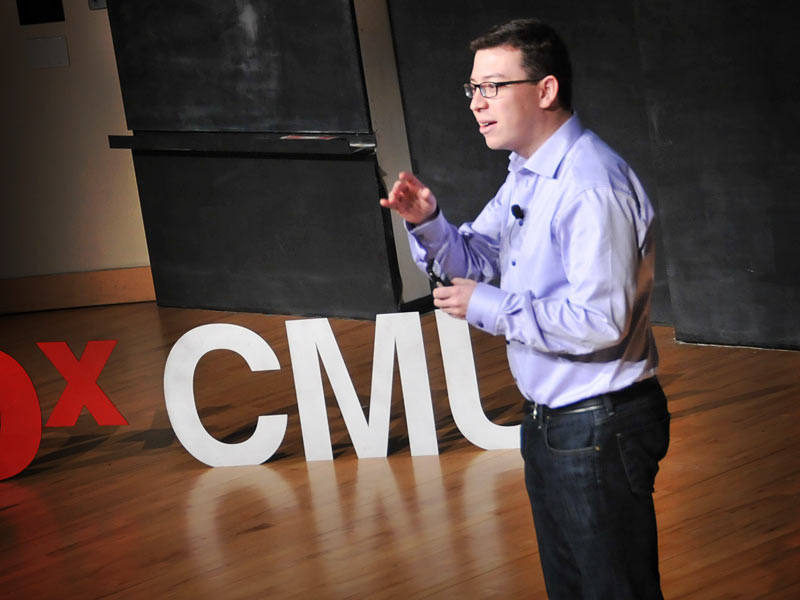
Massive Scale Online Collaboration. What is it? To put it broadly, it is the use of many people who contribute pieces to a greater project. It is a way of turning time and energy into a product instead of money. It is a way of making your mindless web activities into something productive.
Luis von Ahn has found two amazing ways to yield this potential, which he talks about in his TED talk.
reCAPTCHA
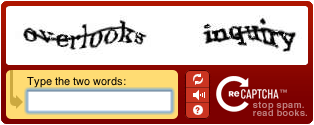
You know how some websites make you read disconfigured text in order to detect whether you are a human or computer? That is something known as CAPTCHA, and it was invented by Luis von Ahn. This precaution has brought much safety to the internet.
But what is reCAPTCHA? After von Ahn realized the amount of time people wasted by filling out these forms, he developed the second edition so that each time you type in a phrase, you're actually helping to digitize books.
The computer projects one word that it knows, and one word it does not. If you correctly identify the word it knows, it assumes the other one is correct. If ten people give the same word, that word has been confirmed transcribed.
And thus, reCAPTCHA not only keeps the internet safe, but also digitizes the wealth of human knowledge simultaneously.
Duolingo

Well I'd be darned. Duolingo, the site that taught me Spanish, the site which I wholly admire, was created by this very same person. Duolingo is able to operate for free because language learners practice their skills by translating internet articles.
So while people learn languages for free, the internet is becoming translated into a multitude of languages simultaneously.
What other ways can the internet be used?
Gabriel García Márquez

Yesterday, the renowned Colombian author Gabriel García Márquez passed away at the age of 87.
My guess is that many people here haven't even heard of his name, let alone his most famous book One Hundred Years of Solitude. García Márquez is one of the most important figures in Latin American literature of all time, and his novel essentially defines the landscape of Latin America, both on a physical and metaphysical level.
He wasn't the first writer of magical realism, but he truly defined the genre. In his books, travelling gypsies would ride magic carpets, storms would rage for years. He turned metaphor into reality for his characters.
Some of his other great books include Love in the Time of Cholera, The Autumn of the Patriarch, Of Love and Other Demons, and The General in His Labrynth (which was often quoted in John Green's Looking for Alaska).
The world of literature has lost a great figure, but hopefully there will be someone to follow in his footsteps.
Subscribe to:
Posts (Atom)